Wednesday, November 23, 2011

The Slovak Canadian Heritage Museum in Oshawa, November 2011


The Slovak Canadian Heritage Museum (SCHM) opened in Oshawa in 2010 with the aim of making audiences ‘aware of Slovak heritage in Canada through the exhibition of heritage artifacts.’ The museum (which had previously been located in Markham, a town to the West of Toronto with a long history of Slovak settlement) opened in Oshawa in a former furniture store, originally belonging to a Mr Michna, a Slovak immigrant who came to Canada in 1924. Of the new location (about 30 minutes to the East of Toronto), museum director Margaret Dvorsky says “it’s a good place to start, the city fathers are happy we are here.”


Museum president Margaret Dvorsky and Jaromir Lukac at the SCHM


Visitors to the museum can try their hand at weaving and a number of other traditional needle crafts. On display are items of bobbin lace, embroidered folk costumes (kroje) and fabrics which have been traditionally printed using wax and indigo dye.
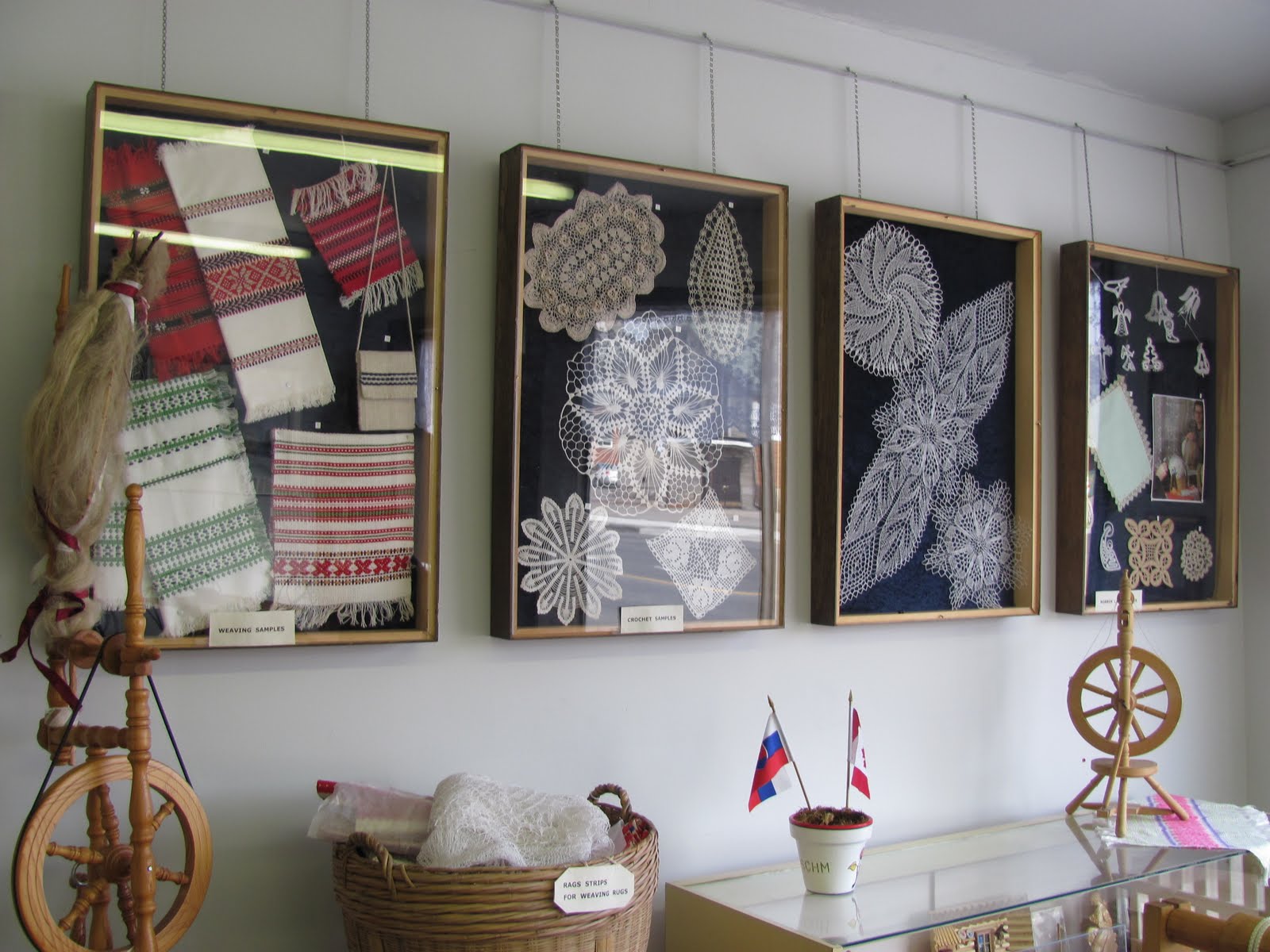

Some of the textiles on display at the SCHM

As well as running the museum itself, Margaret, Jaromir, and other members of the SCHM committee organize an annual Slovak Heritage Festival. They packed Recording Voices & Documenting Memories off with a copy of the very first program for the Slovak Heritage Festival in 2004, which included a bilingual Slovak-English map of the festival site in Markham, ON:


Extracts from the first Slovak Heritage Festival program, 2004

More information about the Slovak Canadian Heritage Museum (including a number of particularly lovely photo galleries) can be found on the organization’s website, at http://www.schm.ca/. The museum is staffed by a corps of volunteers and open from Tuesday through Sunday at 485 Ritson Road, Oshawa, Ontario L1H 5K1.

Wednesday, November 9, 2011

Recording Voices and Documenting Memories in New York City, November 2011

The National Czech & Slovak Museum & Library’s oral history project is coming to New York City. Over the next two years, the NCSML will record the oral histories of 50 Czech & Slovak Cold War-era émigrés, and 25 newer immigrants from the Czech and Slovak Republics who settled in New York after 1989.

The NCSML made a first recording trip to New York City this November. As ever, watch our website for biographical profiles and video clips over the weeks to come. Here though, is a preview of some of the materials we gathered:


Ivana Edwards in her home in New York City, November 2011

Ivana Edwards left Czechoslovakia with her family in 1948. She settled first in Israel and then Canada before coming to the United States to study. This is a snapshot from her first visit back to Prague in the 1960s. Ivana says that she had her hair done specially for the occasion, which is evidenced by this photo:


A well-coiffed Ivana Edwards with her grandmother in Prague

Gabriel Levicky came to New York City from Bratislava in 1979. This was the second time he had left Czechoslovakia, having emigrated to Israel following the Warsaw Pact invasion in 1968 (he then decided to return to Czechoslovakia as part of an amnesty one year later).


Gabriel Levicky, New York City, 2011

Today, Gabriel works as a translator, tour guide and cartoonist. A book of his work, entitled Pardon Me, Which Way to Heaven or Hell; Whatever? was published by the New York Chapter of the Czechoslovak Society of Arts and Sciences (SVU) in 2010.


Cartoon drawn by Gabriel Levicky in Prague, 1990

Tomas Hadl arrived in the United States more than a decade after the Velvet Revolution in 1989. He lived first in Washington, D.C., where he worked as a life-guard, before moving to New York City and starting out as a waiter. Today, he is the manager of the Bohemian Benevolent and Literary Association (BBLA), which is based in New York’s Bohemian National Hall.


Tomas Hadl at the Bohemian National Hall, New York City, 2011

Watch our web pages for excerpts from these interviews (and more) over the weeks to come.

Monday, October 31, 2011

Czech & Slovak Family Restaurants


In the course of working on Recording Voices & Documenting Memories, food has been an important theme, and a good number of the people the National Czech & Slovak Museum & Library has spoken to have owned their own family restaurant, either here in the United States or in Europe prior to their departure.

Dusan Ciran’s stepfather, Emil Sarvady, owned a restaurant in the town of Senica, Western Slovakia, in the run up to WWII (the restaurant in question is pictured above, in more recent times). In this clip from Dusan’s interview with Recording Voices & Documenting Memories, he recalls serving German soldiers there during the War:


Robert Dobson, meanwhile, worked as a waiter (as well as a hair model) in Prague in the 1970s. When he came to Chicago with his family in 1984, he started working as a bartender in the city before buying Pilsner Restaurant in Berwyn three years later. He and his family ran the establishment for the next 13 years. In this clip from his interview, Robert remembers the most popular items on the menu:


Today, Robert runs a remodeling and construction firm based in Bolingbrook, Illinois.


Josef Tousek was a waiter and hotelier in Czechoslovakia before he came to Chicago in 1981. After working at Ciel Bleu French Restaurant in Chicago’s Mayfair Hotel for some years, he set up his own Alpine Banquet House, which now has two branches in the Greater Chicago Area. He shared photos of his restaurant on Roosevelt Road before and after reconstruction with Recording Voices & Documenting Memories:


Photos of Alpine Banquet House before and after renovation

Ales Vesely came to the United States in 1983. Today he works as a barman in Chicago’s Klas Czech Restaurant (where this photograph was taken):


Of Klas Restaurant and the neighborhood, Cicero, in which it is found, Ales says: “…It used to be all Czech over here. I remember we’d drive down Cermak Avenue and there would be Czech butcher shops, a bakery, other restaurants, Czech bars, even Polish places. And now you drive down Cermak Avenue and pretty much it’s all Spanish. This is the last Mohican on Cermak Road. I love this place, it’s very unique."

Thursday, October 20, 2011

Oral History Interviewer, Igor Mikolaska


In late 2010, Slovak-born Igor Mikolaska began working on the Recording Voices & Documenting Memories project as a field interviewer in Chicago. One year and around 30 interviews later, the NCSML asked him a couple of questions about what he had learned through his participation in the project:

“Since I started work on the oral history project I have learned to appreciate the society we live in now. I have realized that people cannot be caged in their opinions and in where they live, since they always strive for freedom. It is a universal law of life and everybody gravitates towards it.”

Which are your favorite and least favorite parts of the job?

“Recording memories that otherwise might be lost is an exciting part of the job and there is a lot to be learned from older generations. Many times I’ve found myself wondering how they were able to find the strength, courage, and amazing tolerance required to go through such a difficult process of creating a new life. On the other hand, getting to where you are actually sitting in front of that person isn’t easy. People find themselves reluctant to open closed chapters of their life, so as not to suffer again.”

Which has been your favorite interview to record and why?

“Vladimir Krman has an amazing story that could be in a Hollywood movie. Three friends meet in a dance hall in Bratislava and orchestrate an extremely difficult escape out of the country. The fact they escaped in an airplane is truly spectacular…


“...Their road to freedom was not an easy one, but I guess they took a shortcut through the sky.”

What is, in your opinion, the importance of oral history projects such as Recording Voices & Documenting Memories?

“I would have been very grateful if somebody had recorded an interview with my grandparents. The stories they told are gone with time and I am left with just a vague image of the life of my grandparents. At the time I did not think of taking a pencil and scribbling down their amazing past adventures and they are lost now. Through documenting the past we can understand better the future and can learn aspects of history that have never been told to anyone. We record stories that otherwise could be lost.”

In which ways do you hope the project develops over the next two years?

“I hope that the oral history project can be used also for educational purposes and as an inspiration to future storytellers. I hope that people will take more interest in the lives of their relatives. I hope that though the project people will also appreciate present times more since this turbulent past is behind us.”

The NCSML has just started recording the oral histories of Czechs and Slovaks, such as Igor, who came to the United States following the fall of Communism in 1989. Watch our website over the coming days to see excerpts from Igor’s interview with Recording Voices & Documenting Memories.

Wednesday, October 12, 2011

Vltava Czech & Slovak Grocery, Chicago


Vltava Czech & Slovak Grocery, W Belmont Ave., Chicago

According to its owner, Tomas Votocek, Vltava is the only shop dedicated exclusively to Czech & Slovak goods in Chicago. Mr Votocek bought the store four years ago and transformed it from a Polish grocer’s into an outlet selling Czech & Slovak food, videos, books and ceramics.


Owner Tomas Votocek behind the counter at Vltava

Vltava is located at 7416 W Belmont Avenue in Chicago and open seven days a week. Customers from further afield can order goods through the store’s Czech-language website, which will then be delivered for a shipping fee throughout the United States.


Books on sale at Vltava - featured is a cookbook from 1968 offering readers 'humorous' recipes

The store stocks a number of Czech and Slovak books and magazines. Books sold are a mixture of brand new and second hand. Earlier this week, there were a large number of cookery books in particular on sale.


Goods on sale at Vltava

Owner Tomas Votocek says he works with a local Polish baker to produce bread baked according to a Czech recipe. Mr Votocek buys perishable Czech & Slovak delicacies like šunka v aspiku (ham in aspic), ruské vejce (egg salad) and chlebíčky (open sandwiches) from a local Czech woman who makes them for him specially. The rest of the food is imported from the Czech Republic and Slovakia.


Singer Karel Gott at Vltava (photo courtesy of vltava.us)

At Vltava, customers can also send parcels, flowers or money orders to the Czech Republic or Slovakia, convert videos from European PAL into US NTSC format and even buy tickets for Czech & Slovak cultural events in Chicago. As the image above shows, Vltava acted as a ticket office for Karel Gott’s 2009 American Tour (more photos can be found online at http://www.vltava.us/gott.html).

Look out for video highlights from Recording Voices & Documenting Memories’ interview with Czech-born owner of Vltava Tomas Votocek on the NCSML’s website over the weeks to come.

-Posted by Rosie Johnston

Thursday, October 6, 2011

The Carpatho-Rusyn Heritage Museum in Parma, Ohio


Trophy awarded as first prize at Cleveland Rusin Day, 1923

This is something of a historic blog post now that the Carpatho-Rusyn Heritage Museum is no longer situated in St. John the Baptist Cathedral in Parma, Ohio. Nonetheless, here are a number of photos taken during a visit to the museum in the Spring of 2010 alongside some information about the Carpatho-Rusyns gleaned in the course of that visit. For more on the Carpatho-Rusyn Heritage Museum - which is in the process of relocating - visit the organization’s website and another great resource is the Carpatho-Rusyn Society’s blog.


Interpretation board at the Carpatho-Rusyn Museum, Parma

Entering the museum, visitors are greeted by a description of who exactly the Carpatho-Rusyns are. An extract from the text on the sign pictured above reads:

“Carpatho-Rusyns are linguistically and culturally an East Slavic people who settled along the northern and southern slopes of the Carpathian Mountains. Their homeland is situated in the area where Slovakia, Ukraine, and Poland meet. Aside from those countries, there are smaller numbers of Carpatho-Rusyns in parts of Romania, Hungary, the Czech Republic, Croatia, and Serbia.”


Map and flag from the Carpatho-Rusyn Museum, Parma

The museum’s website describes the institution’s holding as follows:

“The collection of artifacts includes historical costumes, photographs, documents, maps, folk art, needlework, videos, music and recordings, and a library.”

When Recording Voices & Documenting Memories visited the museum there was a special, seasonal, focus on pysanky (kraslice – painted eggs) and traditional foods prepared at Easter time by the Carpatho-Rusyns.


Pysanky (painted eggs) at different stages of completion, Carpatho-Rusyn Museum

The role of museum guide was played by Maryann Sivak, who came to America from Czechoslovakia in 1968 and co-founded the Carpatho-Rusyn Society here a quarter of a century later. In this clip from her interview with Recording Voices & Documenting Memories, she recalls the difficulty authorities had recognizing her Carpatho-Rusyn ethnicity growing up:


For more on Carpatho-Rusyn culture and news on meetings and events taking place here in the United States, visit the links posted above and the Carpatho-Rusyn Society’s website (http://c-rs.org/).

Friday, September 30, 2011

Recording Voices and Documenting Memories in Prague


Prague Castle, 1938 (photo: Thomas Hasler)

In September, the NCSML went to Prague to interview a number of Czech émigrés who returned home following the Velvet Revolution in 1989. The oral history team also took the chance to meet a couple of other Czechs (and indeed Americans) with interesting stories to tell. Watch our web pages for biographies and clips from the interviews over the months to come. Here, however, is a taster of what to expect:

Eva Eisler moved to New York City with her husband and children in 1983. It was there that she became particularly well known for her jewelry design. She moved back to the Czech Republic some twenty years later and now teaches at Prague’s VŠUP (Academy of Arts, Architecture and Design). When Recording Voices & Documenting Memories visited Eva, she was in the process of installing an exhibit of her students’ work entitled Treasure Hunt at the Czech capital’s Rudolfinum Gallery.


Eva Eisler installing an exhibit, Prague, September 2011


Detail from Treasure Hunt exhibit

Gene Deitch is an American animator (born in Chicago in 1924) who describes himself as “the only free American in Prague during 30 years of Communism.” He moved to the Czechoslovak capital in 1959. Gene and his team of animators at Prague’s Barrandov Studios subsequently won an Oscar for their film Munro. Gene spoke to Recording Voices & Documenting Memories about his decision to move and his time in Central Europe at his studio in Prague’s Malá Strana.


Altered passport photo of Gene Deitch

Meda Mládková went to Geneva, Switzerland as a student in 1946 and decided not to return to Czechoslovakia following the Communist coup in 1948. After more than half a decade in Switzerland, she moved to France where she studied art history and married her husband, Jan Mládek. At the beginning of the 1960s, the pair came to Washington, D.C. on account of Jan’s job at the International Monetary Fund. In 2001, Meda (now widowed) opened a gallery on the Prague island of Kampa where the couple’s collection of Communist-era Central European art could be displayed. Meda now spends her time between Prague and Washington, D.C.


Meda Mládková at Kampa Museum, September 2011


Book published by Meda Mládková (née Sokolová) in exile in Geneva, early 1950s

For full biographies and interview highlights, visit the NCSML's oral history web pages over the months to come.