Showing posts with label 1948. Show all posts

Thursday, June 20, 2013

Related Reading #3: Skutečnost


A Lasting Impression: The Independent Periodical Skutečnost (Reality) was lent to the National Czech & Slovak Museum & Library by Peter Demetz. It is a collection of articles which first appeared in the émigré journal Skutečnost, published in Geneva from 1948 until 1953. The anthology is edited by Czech historian Vilém Prečan.

In his interview with Recording Voices & Documenting Memories, one of the journal’s founders, Peter Hruby, explained the idea behind the publication:


In this collection (published by the Československé dokumentační středisko in 2008), selected articles are presented thematically, with chapters dedicated to Czech-German relations, Czech exiles, Tomáš Garrigue Masaryk and democracy and totalitarianism. Contributors include Peter Hruby and Peter Demetz as well as prominent figures in the Czech émigré community such as Pavel Tigrid and Ferdinand Peroutka.

One of the articles which caught my eye in this anthology was titled Tří měsíce v Americe (or Three Months in America), written by Jan Tumlíř in 1952. The introduction to the article sets out his premise:

“Here are a few unrelated comments and nothing original. Excerpts from diaries and letters and interviews. When you spend so long preparing for America and you are here for such a short time, you cannot be certain whether you are really thinking something or merely remembering something you once read…”

The article continues with a few anecdotes from the author’s life in New Haven and his travels to Cleveland. It concludes:

“I have never thought so often about two things as I have in America: home and death. Home and death, where is the connection?

“If I had stayed there, I probably wouldn’t be able to think about anything other than freedom. Leaving Czechoslovakia was the only way for me not to lose my home, if home is the place you love.”

Skutečnost has a small epilogue in English by editor Vilém Prečan. Otherwise it is in Czech. It can be found for purchase at Kosmas.cz.

Tuesday, May 7, 2013

Related Reading #2: Prague Winter


To mark Secretary Madeleine Albright’s visit to the National Czech & Slovak Museum & Library on May 17-18, Recording Voices & Documenting Memories suggests her most recent book, Prague Winter: A Personal Story of Remembrance and War 1937-1948, as an interesting piece of reading related to the oral history project. 

Prague Winter tells the tale of Secretary Albright’s early childhood in Prague (and then in Great Britain during WWII), and of the more recent discovery of her family’s Jewish background.

Secretary Albright pours over her parents’ diaries and papers to learn more of their WWII experiences. She references correspondence sent to and received from the Protectorate of Bohemia and Moravia throughout the War. She also conducts interviews with relatives and former neighbors as part of her research.

She does so to try and understand “Why we make the choices we do… What prompts one person to act boldly in a moment of crisis and a second to seek shelter in the crowd? Why do some people become stronger in the face of adversity while others quickly lose heart?”

Prague Winter provides a unique eyewitness account of WWII from a Czech émigré perspective. The book is meticulously researched and comments originally on the Czech history of the period.

Prague Winter is sold at the National Czech & Slovak Museum & Library’s store. For more information on purchasing the book, click here.

Monday, November 26, 2012

Related Reading #1: Under a Cruel Star


For those looking for eyewitness accounts of life in (and emigration from) Czechoslovakia in written form, a good place to start might be Under a Cruel Star: A Life in Prague 1941-1968 by Heda Margolius Kovály.

Kovály’s account opens in wartime Prague on the eve of her deportation to the Łódź Ghetto and then Auschwitz. Kovály subsequently describes escaping Nazi captivity and returning to the Czech capital, where former friends turn her away fearing persecution should they assist her.

Following the end of the War, Kovály is reunited with her old companion, Rudolf Margolius, whom she marries. The rest of the book charts Margolius’ rising political star following the Communist coup in 1948, his execution following a notorious show trial in 1952, and Kovály’s persistent efforts to rehabilitate her late husband.

Kovály left Czechoslovakia for the United States following the Warsaw Pact invasion in 1968. She recalls her emigration in the final chapter of her book:

“At the end of September, the invaders were still sitting in full strength at the airports. I boarded a train, carrying two small suitcases and twenty dollars in my pocket.

“The train was crammed. Facing me sat two students, a young man and a girl, who were headed for Holland. We talked about books and about life, and the pretty girl kept complaining that she had left behind her new hat.

“’Don’t you think,’ she kept asking ‘That going into exile would be less awful if I were traveling in a beautiful new hat?’

“Later, a grouchy middle-aged German tourist came into the compartment with her small daughter. The little girl stared at the three of us curiously and then asked, ‘Mutti, why are these people so sad?’”

“Her mother snapped at her ‘Don’t you know the Czechs love their country, you dummy?’…”


Heda Margolius Kovály died in Prague in 2010. For more details on her book, Under a Cruel Star: A Life in Prague 1941-1968, click here.

Tuesday, September 25, 2012

New Transcripts Just In

Recording Voices & Documenting Memories is happy to welcome a new intern. For the past two months, Cecilia Greco has been producing transcripts of interviews with former Czech & Slovak political prisoners and their families. Watch the NCSML's oral history web pages over the weeks to come for the complete transcripts and, in the meantime, here is a taster of what to expect:

Jana Svehlova three weeks before her father's arrest

Jana Svehlova was interviewed in Washington, D.C. in 2010:

"My parents left Czechoslovakia in 1939. But they married in England – they met in England. My father was with the Royal Air Force – with the 311 Czechoslovak Squadron. And my mother managed to get to England as a domestic person. And her War duty was delivering milk to English homes. And all her life she complained about those dirty English women not washing those glass milk bottles properly."

So, both of your parents fled the Nazis?

"Yes, they fled the Nazis. And my father and mother met in Cardiff, because my mother went with her friends to an official Air Force Club in Cardiff. And she was still very sad because her boyfriend in Czechoslovakia told her he wouldn't marry her. But she was persuaded by her friends, and she went. And in walks a group of handsome Czechoslovak airmen. And one of them asked her to marry him – I mean, I'm sorry, to dance with him. And she said yes. And next, he asked her to lend him money for cigarettes. (Laughs) And next thing, they have a date. And then he asked her to marry him because he said, 'look, I'm going to get killed anyway. So why shouldn't a nice Czech girl get a good pension?' And so they married in May 1943. And I must admit, I was born December 1943."

So, when did you then return to Czechoslovakia?

"Well, my father couldn't wait to get back to Czechoslovakia. So in August 1945 – immediately after the War when they demobilized – he went back to Prague. And my mother did not want to return because she was from the Sudetenland, her first language was German, and she didn't have the best memories of Prague just before the War. So she wanted to stay in England, but my father wouldn't hear of it. So, first the families of people who fought with the Allies were flying back. But so many planes crashed that the Red Cross organized that the spouses - basically the wives and the children - would go by train and boat. So my mother and I then came by train to Czechoslovakia in 1945."

... Jana's father was arrested in December 1949, when she was 10 years old. Despite this, Jana says she still has good memories from childhood:

"I was never hungry. My mother told me, and I have lived with this my mother complaining, not having money for example for coal. So, I know that one of the neighbors we found out later that that particular neighbor was the one that was reporting on us to the Secret Police. But she was very nice to us. (Laughs) And she gave us money, or lent us money for coal. And also, when my mother was writing to the president and everybody else, you know, 'Let my husband out; he's been out there now five years; I think he's reeducated.' Because her first language was German, she was never sure about the Czech grammar. So this particular neighbor was also helping her with those letters. And I after my mother died, she died when she was 92 in England and I found she kept all the letters from my father from prison. All those 10 years, year-by-year. So I found those letters and it was kind of funny. Oh, and some of the letters she wrote to the president. And she also wrote a letter to the commandant of the labor camp, 'My husband has been there for seven years now; let him out. I'm sick, and my child needs a father.' And he wrote back, 'Your husband's behavior is not right. He is not reeducated and he plays cards.' Because sometimes when they were down in the mine, you know, the guards wouldn't go down there. So, somebody obviously must have said it that he played cards. (Laughs) My mother wrote back, 'Well, he was a gambler before he went to prison, and I guess the prison hasn't cured him yet.' (Laughs) So, they didn't let him out. Maybe because he was playing cards." (Laughs)

Visit http://www.ncsml.org/Content/Oral-Histories.aspx for more full-length transcripts over the months to come.

Wednesday, August 15, 2012

Barbara Reinfeld’s Refugee Camp Diary, 1948


At a recent oral history shoot, Recording Voices & Documenting Memories interviewee Barbara Reinfeld (née Koháková) shared her childhood diary with us.


Refugees in West German camps were issued with these scrapbooks, which they were encouraged to “keep as a permanent souvenir of the current unpleasantness.” In fact, these diaries had been repurposed from World War II, when they were intended to lift the spirits of prisoners of war.


In her diary, Barbara documents moving from one refugee camp to another, shopping in American military PX stores, receiving CARE packages and comparing the taste of Coca Cola and Pepsi Cola.


The diary contains a number of photos, including these images of a wedding in Barbara’s refugee camp in August, 1948. Note that the wedding car is a decorated International Refugee Organization jeep.

While in West Germany, Barbara and her family were in touch with the Alexander family in the United States. In the summer of 1948, they sent the Koháks a photo of their children with the following inscription:

“This is to show Raza & Barbara how American children dress in the Middle West. Willa’s shorts are navy blue, her shirt a red plaid. Buzz’ are navy blue cowboy jeans with a light blue plaid shirt. David’s T-shirt is bright blue, his pants are of U.S. army material – khaki colored. The picture was taken for you – the children knew why, which is no doubt why they look so serious.”


Barbara started seventh grade in fall 1948, where she made a number of friends mentioned throughout this diary. To her entry for September 20, 1948 she attaches this invite to her friend Virginia Rice’s party at which, she is reassured, “there will not be any boys there.”   

 
For clips from Barbara Reinfeld’s oral history, watch the NCSML’s oral history pages over the months to come.

Tuesday, June 26, 2012

Peter Palecek on his father, General Václav Paleček


In his interview with Recording Voices & Documenting Memories, Peter Palecek shared a number of documents and details about his father, the late General Václav Paleček. In addition to what you can find at www.ncsml.org, here is a bit more about General Paleček, in his son’s own words:

Photo of Vaclav Paleček courtesy of his son, Peter
“My father Václav Paleček was born on November 20, 1901 in Plzeň, western Bohemia. He became President of the National Union of Czechoslovak Students in the interwar period. Between 1934 and 1939, he served as Secretary General of the Czechoslovak-Yugoslav Chamber of Commerce, in which capacity he made frequent trips to Yugoslavia. In late 1939, he escaped occupied Czechoslovakia through Yugoslavia and Italy to join the Czechoslovak troops in France. After France fell to Hitler in June 1940, the Czechoslovak troops moved from France to London, where he joined the Czechoslovak government-in-exile. He worked first for the Ministry of Finance under Ladislav Feierabend and later for the Ministry of Foreign Affairs under Jan Masaryk. My father was instrumental in organizing international students against Nazi Germany and became co-founder and president of International Students’ Day on November 17, 1941 in London. Later, as president of the World Youth Council, he was invited for a six-month lecture tour of the United States by First Lady Eleanor Roosevelt. He spoke at 56 conferences and discussions on the postwar economic reconstruction of Europe in 39 states of the Union. The lecture tour culminated with a visit to Vice President Henry Wallace in the White House in December 1943. The six months of lectures throughout the United States, which addressed thousands of students (as well as a broader American public), represented one of the most significant promotional efforts for Czechoslovakia in the United States ever.

Wartime photo of General Paleček
“After the War, in June 1945, my father was named Chief of the Czechoslovak Military Mission in Berlin. He dealt with war reparations, the design and implementation of the Marshall Plan, the repatriation of Germans, and a myriad of other issues critical for his homeland. Following the Communist coup in Czechoslovakia in 1948, he was arrested and sentenced to 13 years in prison. In 1957, his sentence was reduced to 7 years and with poor health impacted by many years of working in uranium mines he returned to his family. His sentence was nullified in 1967 but as a former political prisoner he was unable to find a job. He traveled to the United States to visit me at Stanford in 1970 and it was here that he died on March 22.”

In this clip from Peter Palecek’s interview with Recording Voices & Documenting Memories, he remembers visiting his father in jail in western Bohemia in the 1950s:


For Czech readers, more about General Václav Paleček can be found in Josef Pejskar’s four-volume work Posledni pocta, which maps Czech and Slovak emigration from 1939-1994.

Thursday, April 5, 2012

Resistance Against Communism in Czechoslovakia


Photo of the Masin brothers, California, 1980s

In the first of a series of posts, Recording Voices & Documenting Memories is showcasing the work of history students at Utah State University who used NCSML oral histories to write research papers for their Eastern Europe Since 1500 class. Topics covered ranged from gender studies to dissent and activism in Czechoslovakia during the Cold War era.

For her paper, Tess Murray chose the theme of Resistance Against Communism in Czechoslovakia:

In this essay I will argue that all acts of resistance against the Communist regime in Czechoslovakia were effective to a degree. I will first discuss how the communists were able to seize power in Czechoslovakia. I will then examine what I believe to be the definition of resistance. I will then explore the effectiveness of the extraordinary acts of resistance performed by ordinary men such as Josef Masin, Radek Masin, and Karel Ruml.

When thinking of a seizure of power, people tend to think of it in terms of either a violent revolution or a foreign government imposing itself on the locals. In places such as Poland, the Red Army was in fact needed to enforce communism. This was not the case in Czechoslovakia. The Communist Party in Czechoslovakia came to power through their own efforts. The Communist party was one of the most organized political parties at the time and it had plenty of training and resources at its disposal. They were able to undermine any non-communist party. They did this by rewarding communist sympathizers within the other parties. Communism was also extremely popular because it was seen as a system that was the antithesis of the Nazi establishment. Communism became even more popular as it promoted the displacement of anyone seen as a Nazi collaborator. By 1947 communists had gained thirty-eight percent of the vote in Czechoslovakia. The vote reached roughly fifty percent when including the vote of social democrats. Many of the people in Czechoslovakia believed in the ideology of communism so deeply that they were willing to overlook its failures and inconsistencies. This is shown by a statement made by the Czechoslovakian communist supporter Rudolf Margolius. He said, “I cannot give up my conviction that my ideal is essentially sound and good, just as I cannot explain why it has failed---as it apparently has.” Communism did not come to power in Czechoslovakia by force, it was chosen by the people.

With every system there is going to be some form of resistance regardless of how popular it is. But what exactly defines effective resistance? I believe the words of Vaclav Havel describe resistance very well, “...individuals who were willing to live within the truth, even when things were at their worst.” This is the core of every form of resistance. Men and women are resisting when they are willing to realize the lie they are living in and call it what it really is. The mere act of being aware of the facade makes it crumble. By taking any action against a defective system it can be exposed as a fake. This leads to the system being further examined which in turn causes it to become more vulnerable to further resistance. In the case of the communist regime in Czechoslovakia, any action that caused people to question the validity of the regime was effective resistance. While a single act on its own may have not brought about the downfall of communism, it was by little actions that the seeds of further resistance were sown. Essentially, effective resistance is anything that reveals a broken system for what it really is.


Josef Masin, Germany, 1964

A man who effectively resisted communism in Czechoslovakia was Josef Masin. He became a part of an underground resistance group at a young age. When stating why he did it he said, “We fought, we wanted to fight for something, for Czechoslovakia.” Josef helped obtain weapons that would assist them in leaving the country. He also helped his group steal 850,000 crowns. They disguised themselves in militia uniforms and car jacked a van that was carrying money from a factory that made tractor parts. They used this money to fund further acts of resistance. He successfully escaped from Czechoslovakia with four other men to Berlin, causing an extensive man hunt to occur. No matter how many times he was imprisoned or tortured he would still continue to look for little ways in which he could resist a regime that he did not agree with. While his actions within the group did not bring down communism itself it exposed the cracks in its foundation.


Radek Masin, circa 1960

Radek Masin also resisted against communism in Czechoslovakia. He was continually planning ways to sabotage the communist regime. He tried to get in the army to attack it from within. When that did not work he planned to make it to the west and receive training there. While in the midst of a plan to leave the country he was caught. This led to his arrest and eventual conviction in a farcical trial. He was imprisoned for over two years and forced to work in a uranium mine. Even while working in the camp as a prisoner he was plotting ways to steal explosives to use in resistance activities. He tried to get information by borrowing books on explosives from the prison library. He also participated in other acts of resistance such as burning large amounts of straw. He felt this was a triumph not only because they destroyed so much, but because of the psychological impact it had. While this was never reported by the press, this little act caused quite a stir as it got passed through the grapevine. The effect of this action was that it caused people to start talking. And when people start talking they start to question. He knew that it was the little stuff that worked. He himself said, “We did not have any grandiose plans, you know, like ‘Oh we are going to overthrow the regime.’ That was quite obvious that you cannot do it. You just have to do whatever you can do. Even if it is small stuff.” These little actions were effective because they put the people collaborating with the regime on edge. It was also effective because it started conversations that needed to be had about what was really happening within the Communist regime.


Karel Ruml, 1949

Another man that helped resist communism was Karel Ruml. He had come to a disturbing conclusion about communism. After seeing prisoners in a work camp he said, “It sort of dawned on me then, that in a communist society people who were not healthy and capable of physical labor for the state were not expected to live very long.” A small way in which Karel resisted was by delivering mail that contained microfilm to certain locations. He also sent and received coded messages via the phone or postcards. Karel also resisted by participating in an act later named by the western press as “the freedom train”. During this act his job was to protect the hand brake on a train. He was to fend off any person who tried to stop the train. They were able to hurtle this train and its passengers safely into Germany. There were students on the train that made the choice to not go back to Czechoslovakia. His act of resistance enabled them to have this choice. This act of resistance was effective because it was highly publicized. It gave people back in Czechoslovakia an example to follow. It may have made people who were blinded by the ideology of communism stop a moment and ponder what communism was leading people to do.

Effective resistance makes people examine the world around them. Every act that was performed by these men promoted people living in a lie to do just that. By making people begin to probe the limits of their world, it can be argued that those small acts of resistance were successful. All that is necessary for change to begin to happen is an honest conversation. When actions or words lead to this type of conversation they most certainly should be deemed effective. No these acts of resistance in and of themselves did not bring about the fall of communism. But they were most certainly a catalyst. This ultimately means that any single act or any single person can create an environment in which great and often seemingly impossible things can occur. Small measures may seem insignificant to some but just look at the impact these men had. The point being, if a person wants change, the first thing they must do is be candid with themselves about the world around them. This will allow them to begin living in truth. Change will surely follow.

Thursday, March 29, 2012

American Sokol Headquarters, Brookfield


Chicagoland Sokol poster, date unknown

American Sokol was founded in St. Louis in 1865. Today, its headquarters are in Brookfield, Illinois.


Jean Hruby, American Sokol Headquarters, March 2012

Jean Hruby is American Sokol’s business manager. She says the organization is a non-political, non-religious, nonprofit active across the United States – particularly throughout the Midwest, on the East Coast and in Texas.


Bust of Sokol founder Miroslav Tyrš, American Sokol Headquarters

Czech patriot Miroslav Tyrš founded the Sokol movement in the Czech lands in 1862. According to Jean Hruby, American Sokol stays true to his principles to this day; Sokol members adhere to Tyrš’s credo of ‘a sound mind in a sound body’ through attending Sokol fitness, gymnastics (and even Zumba) classes, and cultural events put on by the organization.


'Anthem Etiquette' on the cover of American Sokol's newsletter, October 2011

Patriotism plays an important role in the Sokol ideology. Many of the organization’s members are both patriotic Czechs and Americans.


Artifacts (including a Czech governmental Gratias Agit award) and yearbooks on display at American Sokol

The headquarters of American Sokol in Brookfield double up as a library and archive housing the history of the organization. Researchers can visit the collections by making an appointment.


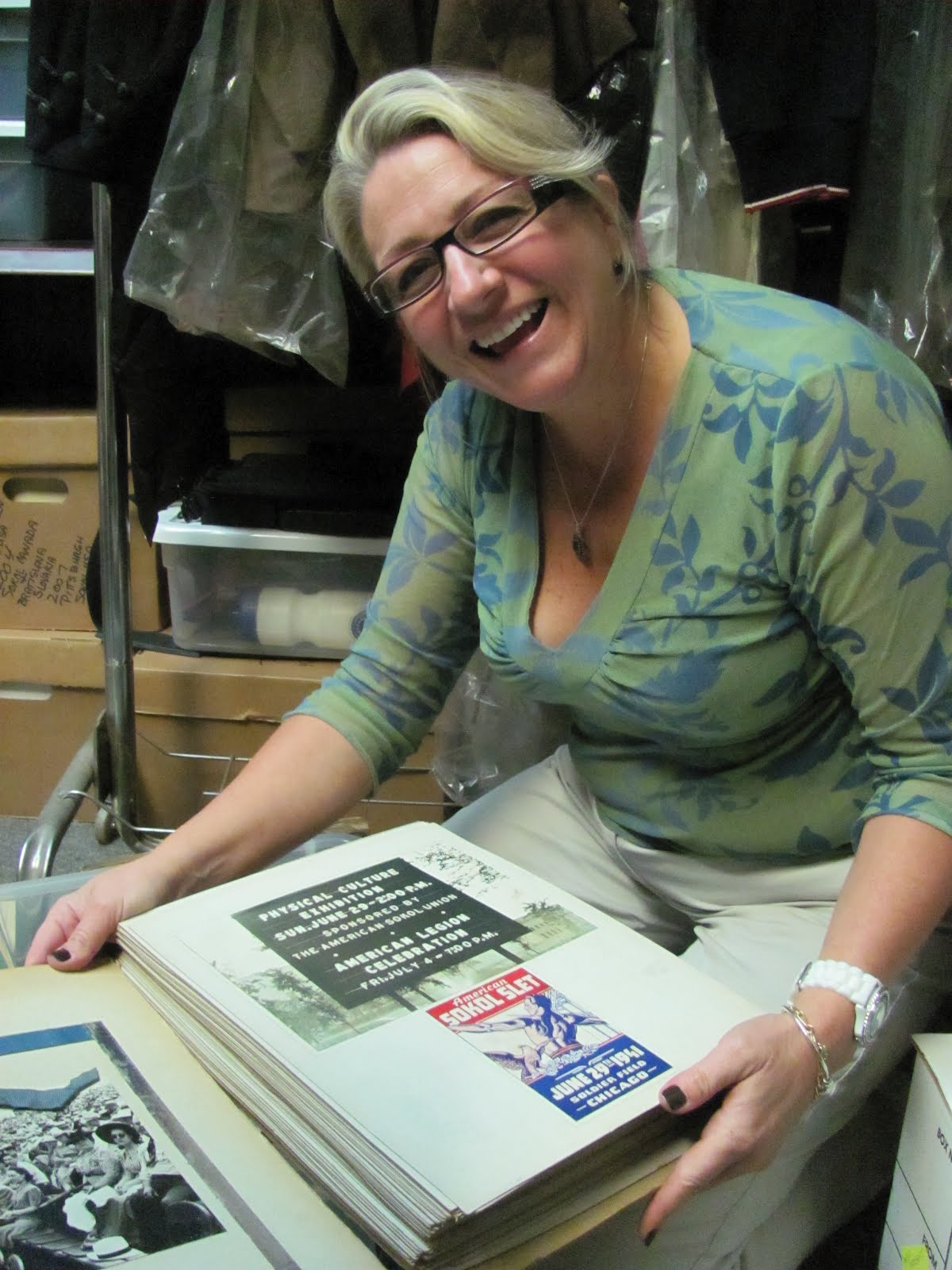
Above: Jean Hruby with a photo album from a Sokol slet at Chicago's Soldier Field, below: a photo from the album showing slet participants, 1941

The archives are particularly rich in photos and other documentation of previous Sokol slets – mass gymnastics festivals at which thousands of Sokol members perform synchronized gymnastics routines.


Photo from the Prague Sokol slet of 1948

For more information on American Sokol and the organization’s library and archives, visit www.american-sokol.org.

Tuesday, March 27, 2012

Recording Voices & Documenting Memories in the San Francisco Bay Area

The NCSML’s recent trip to California uncovered all sorts of particularly interesting historical documents and stories. Here are some of the highlights from Recording Voices & Documenting Memories most recent material-gathering expedition:


Georgina Teyrovsky’s father was a member of the Czechoslovak Legions in Russia. In this photo from 1918 he is at work as a telegraphist (sitting in the bottom row, second from left).


George Malek originally immigrated to Canada before coming to the United States to work in what was a fledgling Silicon Valley. During his interview with Recording Voices & Documenting Memories, he shared this picture with us: the photo shows his mother, who was a member of a Sokol dance troupe in Czechoslovakia prior to WWII. She is the dancer in the front row furthest to the right.


Two images of Prague during the Warsaw Pact Invasion, 1968

George Skoda left Czechoslovakia in 1948. He subsequently settled in the Bay Area and worked on the Stanford Two-Mile Accelerator. He says that he was sent the photos above by a friend in Prague following the Soviet-led invasion of Czechoslovakia in 1968.


Peter and Hana Palecek arrived in the Bay Area in the late 1960s. Although they were married at the time, the pair arrived in the United States separately, and in totally different ways. The Paleceks both shared their stories with Recording Voices & Documenting Memories.

Excerpts from all of these interviews, and more from the NCSML’s recording trip to the Bay Area, will appear on the National Czech & Slovak Museum & Library’s oral history web pages over the weeks and months to come.

Thursday, December 1, 2011

Recording Voices & Documenting Memories in Toronto, November 2011

This November, the NCSML was invited to Toronto to present Recording Voices & Documenting Memories. Never ones to pass up on a good recording opportunity, we met a number of Czechs and Slovaks who immigrated to Canada over the past 60+ years whilst we were in town. As ever, look to our web pages for excerpts from the interviews over the next couple of weeks. Here is a fraction of the interesting photos and other archival documents which our interviewees shared with us when we visited their homes:


Czech ball, Montreal - photo courtesy of George Heller

George Heller came to Canada with his parents shortly after the Communist coup in 1948. The family settled in Montreal. The photo above shows George’s parents (on the far right) at the city's yearly Czech & Slovak ball, which he says was the émigré community’s annual social highlight.


Photo of George Heller's father, Havlickuv Brod, 1948

Prior to leaving Czechoslovakia, George’s father was a baker. In this photo from 1948, George’s father is shown taking part in a parade in Havlickuv Brod representing the bakery he worked for at the time, named Rozvoj (meaning progress or development in Czech). Along the side of the truck are both Czech and Soviet flags and a caption which reads “sixty-nine wagons of bread baked in 1947 – 4,650,000 bakery items.”


George (in the blue coat on the right) with Queen Elizabeth II, 1994

When George was 18, he answered an advert posted by the Hudson’s Bay Company recruiting fur traders to work in Canada’s Northern Territories. He enjoyed tremendous success at this job and, after a number of promotions and some time spent in other firms, rose to the position of president and CEO of The Bay. He took some time off from this job to organize the 1994 Commonwealth Games, which were held in Vancouver. In the photo above, George is watching the Games’ opening ceremony with Queen Elizabeth II and the Duke of Edinburgh.


Dagmar Benedik with fellow members of the swim team, Kladno

Dagmar Benedik left Czechoslovakia with her family in 1968. Prior to emigration, she attended junior and senior high school in Kladno, where her father was coach of the junior hockey team, and enjoyed swimming competitively for the city, as evidenced by the photo above, in which Dagmar can be seen on the top left.


Envelope containing correspondence from Dagmar's pen pal

Following her interview with Recording Voices & Documenting Memories, Dagmar shared a number of interesting documents with the NCSML, including this envelope which she received from her pen pal in the Soviet Union in the 1960s. Dagmar says that Czech and Slovak schoolchildren would often write to a peer in the Soviet Union as part of their Russian language training at this time. This particular letter came encased in an envelope commemorating February 23 - Soviet Army Day.


Milos Krajny upon arrival in Canada beside Professor Julius Axelrod (left)

Milos Krajny also came to Canada in 1968 to work in Quebec as a medical doctor. He subsequently moved to Toronto where he opened his own practice and, among other achievements, became the president of the Toronto Philharmonic. Dr. Krajny is extremely active in the Czech community in Toronto and organizes a series of classical music performances called Nocturnes in the City, about which more details can be found here.

Excerpts from all three of these interviews and more will be posted to www.ncsml.org over the weeks to come.

Wednesday, November 9, 2011

Recording Voices and Documenting Memories in New York City, November 2011

The National Czech & Slovak Museum & Library’s oral history project is coming to New York City. Over the next two years, the NCSML will record the oral histories of 50 Czech & Slovak Cold War-era émigrés, and 25 newer immigrants from the Czech and Slovak Republics who settled in New York after 1989.

The NCSML made a first recording trip to New York City this November. As ever, watch our website for biographical profiles and video clips over the weeks to come. Here though, is a preview of some of the materials we gathered:


Ivana Edwards in her home in New York City, November 2011

Ivana Edwards left Czechoslovakia with her family in 1948. She settled first in Israel and then Canada before coming to the United States to study. This is a snapshot from her first visit back to Prague in the 1960s. Ivana says that she had her hair done specially for the occasion, which is evidenced by this photo:


A well-coiffed Ivana Edwards with her grandmother in Prague

Gabriel Levicky came to New York City from Bratislava in 1979. This was the second time he had left Czechoslovakia, having emigrated to Israel following the Warsaw Pact invasion in 1968 (he then decided to return to Czechoslovakia as part of an amnesty one year later).


Gabriel Levicky, New York City, 2011

Today, Gabriel works as a translator, tour guide and cartoonist. A book of his work, entitled Pardon Me, Which Way to Heaven or Hell; Whatever? was published by the New York Chapter of the Czechoslovak Society of Arts and Sciences (SVU) in 2010.


Cartoon drawn by Gabriel Levicky in Prague, 1990

Tomas Hadl arrived in the United States more than a decade after the Velvet Revolution in 1989. He lived first in Washington, D.C., where he worked as a life-guard, before moving to New York City and starting out as a waiter. Today, he is the manager of the Bohemian Benevolent and Literary Association (BBLA), which is based in New York’s Bohemian National Hall.


Tomas Hadl at the Bohemian National Hall, New York City, 2011

Watch our web pages for excerpts from these interviews (and more) over the weeks to come.

Wednesday, July 6, 2011

Slovo, Summer 2011


Cover of Slovo, Summer 2011

A new edition of the NCSML’s journal Slovo is out, and the whole issue is devoted to Recording Voices & Documenting Memories. Here are extracts from some of the articles written for Slovo by oral history project participants alongside images they shared with the NCSML at the time of their interview.


Portrait of Karel Ruml, 1949

Karel Ruml left Czechoslovakia in 1951 by “crashing a train through the Iron Curtain into West Germany.” In this edition of Slovo, he remembers his escape:

“My own task was to prevent anyone from using the single manual brake in my coach. With the train in motion… I got up and walked slowly to the end of the corridor, where I casually leaned on the wheel of the brake. Soon we were racing through As and a big, self-assured border guard tried to push me aside. I quickly drew my gun and ordered him to stop and keep quiet. He glared at me with a mixture of hate and cowardice, but didn’t move… We finally stopped among farm fields. Not too far behind us was a forested ridge bristling with watch towers and barbed wire – the Iron Curtain… Bewildered passengers [milled] outside the train.”


Birthday card designed by John Palka, circa 1950

In Twice Displaced But Not Defeated John Palka (who came to the United States in 1941 and then again in 1949) writes:

“…My parents worked hard to raise me with a dual identity – that of a devoted American grateful to his new homeland for the safety and opportunities it offered him, but also that of a Slovak who knew about and was proud of his heritage. In this they succeeded, for that is the way I still see myself today. After her death, I found in my mother’s files a memento that expresses this duality perfectly, a birthday card I made for her. On the front I wrote Happy Birthday and Št’astlivé narodzeniny, and on the back I drew two flags, the Czechoslovak above and the U.S. flag below. I was 11 or 12 when I sat down with my crayons to make this card.”


Jana Svehlova with her father, Jan Roubik, in England during WWII

Jana Svehlova is the founder of a non-governmental organization called The Enemy’s Daughters. She herself is the daughter of a political prisoner, her father having been arrested in 1949 because he was an RAF pilot during WWII and, she says, “the communist regime viewed those who had fought for the Allies with hostility.” In Slovo, Jana recollects her father’s arrest:

“The only clear image I have of that day is the color of my dad’s face when the agents were taking him away at 9 o’clock in the morning – stark white. I did ask one of the men, 'Where are you taking my daddy?' The security agent answered, 'We have to ask him some questions.' My father was arrested and sentenced to 10 years of hard labor… My mother and I were able to visit him about two times a year.”


Vladimir Maule's ID card, circa 1969

In From Lenin to Lennon, Vladimir Maule remembers his youth in Prague and journey to America in 1969. He settled with his mother in what was then a particularly Czech neighborhood of Chicago:

“As we walked along 26th Street, we heard some voices speaking in Czech. The sound was coming out of a travel agency. It was a social group of elderly Czechs at their monthly meeting, where they discussed global events and exchanged cooking recipes. They were genuinely happy to help. They found a place for us to stay the first night and recommended where to apply for work – my mom at Western Electric and I at a steel company called CECO. The next day we were both hired. (I had taken the wrong bus so ended up at Sears.) We found a basement apartment in Berwyn, a Chicago suburb with a sizable Czech population. We were on a roll.”

Vladimir talks more about the mix-up which led him to find employment at Sears (and not CECO) in this clip from his oral history interview:


Also in this edition of Slovo are articles by project participants Melania Rakytiak and Peter Hruby. Slovo is sent to all NCSML members and can be purchased at the museum store in Cedar Rapids.