Showing posts with label Cleveland. Show all posts

Friday, July 26, 2013

Leaving Czechoslovakia comes to Cleveland


The National Czech & Slovak Museum & Library's traveling oral history exhibit, Leaving Czechoslovakia, is currently on display at Cleveland's Bohemian National Hall. Click here for a list of opening times and directions.

On Sunday, July 28 Project Coordinator Rosie Johnston and the NCSML's Director of National Development Charity Tyler will be on hand to discuss the exhibit's creation, and the work that the NCSML has been doing more generally over the past couple of years - in Cedar Rapids and around the country.

The NCSML is excited about presenting Leaving Czechoslovakia in Cleveland, as so many of the materials used in the exhibit originally came from oral histories recorded in the city. The exhibit contains excerpts from interviews with Zdenka Necasek and Melania Rakytiak, and artifacts such as this theater program, which was shared with the NCSML by interviewee Kveta Eakin:


The presentation of Leaving Czechoslovakia will take place on Sunday, July 28 at 3:00pm at the Bohemian National Hall. For photos of the event, watch this space!

Thursday, June 20, 2013

Related Reading #3: Skutečnost


A Lasting Impression: The Independent Periodical Skutečnost (Reality) was lent to the National Czech & Slovak Museum & Library by Peter Demetz. It is a collection of articles which first appeared in the émigré journal Skutečnost, published in Geneva from 1948 until 1953. The anthology is edited by Czech historian Vilém Prečan.

In his interview with Recording Voices & Documenting Memories, one of the journal’s founders, Peter Hruby, explained the idea behind the publication:


In this collection (published by the Československé dokumentační středisko in 2008), selected articles are presented thematically, with chapters dedicated to Czech-German relations, Czech exiles, Tomáš Garrigue Masaryk and democracy and totalitarianism. Contributors include Peter Hruby and Peter Demetz as well as prominent figures in the Czech émigré community such as Pavel Tigrid and Ferdinand Peroutka.

One of the articles which caught my eye in this anthology was titled Tří měsíce v Americe (or Three Months in America), written by Jan Tumlíř in 1952. The introduction to the article sets out his premise:

“Here are a few unrelated comments and nothing original. Excerpts from diaries and letters and interviews. When you spend so long preparing for America and you are here for such a short time, you cannot be certain whether you are really thinking something or merely remembering something you once read…”

The article continues with a few anecdotes from the author’s life in New Haven and his travels to Cleveland. It concludes:

“I have never thought so often about two things as I have in America: home and death. Home and death, where is the connection?

“If I had stayed there, I probably wouldn’t be able to think about anything other than freedom. Leaving Czechoslovakia was the only way for me not to lose my home, if home is the place you love.”

Skutečnost has a small epilogue in English by editor Vilém Prečan. Otherwise it is in Czech. It can be found for purchase at Kosmas.cz.

Thursday, October 6, 2011

The Carpatho-Rusyn Heritage Museum in Parma, Ohio


Trophy awarded as first prize at Cleveland Rusin Day, 1923

This is something of a historic blog post now that the Carpatho-Rusyn Heritage Museum is no longer situated in St. John the Baptist Cathedral in Parma, Ohio. Nonetheless, here are a number of photos taken during a visit to the museum in the Spring of 2010 alongside some information about the Carpatho-Rusyns gleaned in the course of that visit. For more on the Carpatho-Rusyn Heritage Museum - which is in the process of relocating - visit the organization’s website and another great resource is the Carpatho-Rusyn Society’s blog.


Interpretation board at the Carpatho-Rusyn Museum, Parma

Entering the museum, visitors are greeted by a description of who exactly the Carpatho-Rusyns are. An extract from the text on the sign pictured above reads:

“Carpatho-Rusyns are linguistically and culturally an East Slavic people who settled along the northern and southern slopes of the Carpathian Mountains. Their homeland is situated in the area where Slovakia, Ukraine, and Poland meet. Aside from those countries, there are smaller numbers of Carpatho-Rusyns in parts of Romania, Hungary, the Czech Republic, Croatia, and Serbia.”


Map and flag from the Carpatho-Rusyn Museum, Parma

The museum’s website describes the institution’s holding as follows:

“The collection of artifacts includes historical costumes, photographs, documents, maps, folk art, needlework, videos, music and recordings, and a library.”

When Recording Voices & Documenting Memories visited the museum there was a special, seasonal, focus on pysanky (kraslice – painted eggs) and traditional foods prepared at Easter time by the Carpatho-Rusyns.


Pysanky (painted eggs) at different stages of completion, Carpatho-Rusyn Museum

The role of museum guide was played by Maryann Sivak, who came to America from Czechoslovakia in 1968 and co-founded the Carpatho-Rusyn Society here a quarter of a century later. In this clip from her interview with Recording Voices & Documenting Memories, she recalls the difficulty authorities had recognizing her Carpatho-Rusyn ethnicity growing up:


For more on Carpatho-Rusyn culture and news on meetings and events taking place here in the United States, visit the links posted above and the Carpatho-Rusyn Society’s website (http://c-rs.org/).

Monday, August 22, 2011

The Czechoslovak Society of Arts & Sciences

The Czechoslovak Society of Arts & Sciences (Společnost pro vědy a umění - SVU) was founded in Washington, DC in 1958. According to the organization’s website, the main goal of the society was ‘to provide a forum for the free development of Czechoslovak culture in exile and make the world aware of Czech and Slovak cultural traditions, which date back more than a millennium.’


SVU Presidents Jan Mladek, Jan Triska, Rene Wellek, Mila Rechcigl, Frantisek Schwarzenberg and Jaroslav Nemec at the 9th SVU World Congress, Cleveland, 1978

The SVU’s first president was Professor Vaclav Hlavaty. The longest-serving head of the organization, however, was Dr. Miloslav (Mila) Rechcigl who led the SVU from 1974-1978 and then again from 1994-2006. Dr. Rechcigl became involved in the organization shortly after its creation; in his interview with Recording Voices & Documenting Memories, he discusses the context in which the SVU was formed:


Today, the SVU has different, expanded functions. The society wants to ‘become a bridge between Czech and Slovak professionals and those in other countries. It allows scholars abroad to benefit from contact with their Czech and Slovak colleagues, as well as helping to reintegrate the intellectual life of these two nations into the main stream of world science, arts and letters, from which they were separated for so long by political barriers.’

One of the ways in which the society attempts to facilitate communication between Czech & Slovak professionals is through its very useful SVU Directory, which lists contacts and brief biographical details for each of the organization’s members:


The well-worn copy of the SVU Directory used by Recording Voices & Documenting Memories

The SVU continues to publish a review entitled Kosmas as well as a number of books. In Washington, DC (where the local SVU chapter continues to be particularly active) an annual Christmas bazaar of Czech & Slovak crafts remains particularly popular. Dagmar White is an SVU member who contributes each year to the Christmas fair; she believes the organization’s purpose is changing:


The SVU is known in particular for its biannual World Congresses (which Dr. Rechcigl has been involved in since the inaugural meeting in 1962). The next World Congress will be held in 2012 in Žilina, Slovakia. For more details, check the SVU’s website over the coming months.

In the course of Recording Voices & Documenting Memories, many people have spoken of their involvement with the SVU. For more on the organization over the years, see Zdenek David, Vera Borkovec and Paul Burik's full-length interviews.

Thursday, August 4, 2011

The Slovak Institute, Cleveland


The Slovak Institute, Spring 2010

The Slovak Institute was opened in Cleveland in 1952. It houses books and publications which, according to its website, “explore the growth of the Slovak people both in Slovakia and around the world.” It can be found in St Andrew Abbey, on Cleveland’s Buckeye Road.


Two views of St Andrew Abbey, Cleveland

As well as books, the Slovak Institute houses traditional kroje (or folk costumes), pictures of Slovak personalities, and even the ashes of First Slovak Republic President Jozef Tiso and politician Andrej Hlinka.


Ashes of Andrej Hlinka


Some of the items and pictures on display at the Slovak Institute

For many years the Slovak Institute had a publishing arm. It brought out journals and reviews pertaining to religion and culture.


Copy of Slavistica from 1964, published by the Slovak Institute

The Institute has impressive document collections pertaining to Slovak-American organizations and personalities. Correspondence, newspaper clippings and articles from various publications are collected and filed for the public to access from Monday to Friday, 10am-3pm.


Personality file at the Slovak Institute

The Slovak Institute currently has a staff of two. Joe Hornack, an American of both Slovak and Czech extraction has been helping out at the Institute for the past few years.


Joe Hornack at the Slovak Institute, Spring 2010

…While the Institute’s director since 2002 has been Andrew Hudak. He talked to Recording Voices & Documenting Memories about his role:


More information about the Slovak Institute can be found on its website (http://www.slovakinstitute.com/) and by phone at (216) 721-5300 Ext. 294.

Tuesday, July 26, 2011

Holúbky making for the Cleveland Slovak Festival, September 2010

The Cleveland Slovak Festival has been held annually over the Labor Day weekend since 1971. Last year, it took place at St. Anthony of Padua Church in Parma, Ohio. Festivalgoers enjoyed a number of accordion bands, Slovak folk dance performances, Zlatý bažant beer and hearty portions of Slovak food.

Ahead of the festival on September 4, I joined the twenty-some volunteers preparing holúbky for the festival. Holúbky (which literally means ‘pigeons’) are stuffed cabbage leaves traditionally made, according to those at the festival, in the eastern Zemplín region of Slovakia. Here’s a photo guide showing how to make the perfect stuffed cabbage leaf:


First of all, you need to boil your cabbage. This makes the individual leaves more pliable so you can wrap them easily around the stuffing later on. At the festival, the hearts of each cabbage were then used in a tomato/cabbage-based sauce served over each of the holúbky. From my understanding, this is something of an optional flourish; holúbky can be served plain as well.


This photo of a fraction of the boiled cabbage leaves piled high gives you an idea of the quantities of holúbky being made for the festival.


Next up is the stuffing: the recipe used at the Slovak festival called for pork and beef to be mixed with rice and seasoned with salt and pepper. Onions sautéed in butter were also added to the mixture and worked in, as you can see, using a good deal of elbow grease.
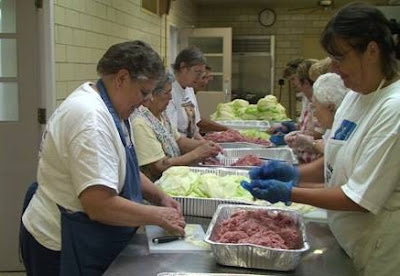


With the leaves and the stuffing now prepared, it was time to make the holúbky themselves. To do so, small meatballs were prepared (as shown on the front right of this picture) and then wrapped in cabbage leaves (as shown on the front left).


Finally, the end of the cabbage leaf needs to be tucked into the roll so that the filling stays firmly in place. If the cabbage leaf is too long, then Mary Lesko (pictured) suggests you should cut it down so that it fits better. The scraps of cabbage left over became part of the holúbky sauce.

At the festival, the holúbky sold like hot pigeons and I didn’t notice any left at the end of the day. According to festival founder Paul Brunovsky, who spoke to the NCSML’s Recording Voices & Documenting Memories, food and drink have proven to be a major part of the event's allure since it was founded 40 years ago:


This year, the Cleveland Slovak Festival will be held on September 4th, again at St. Anthony of Padua Church in Parma, Ohio. The NCSML will be there with information about the museum and Slovak products for sale.

Tuesday, July 19, 2011

Cleveland's Czech Cultural Garden

The Cleveland Cultural Gardens came into being in the early 1900s on land that had been donated to the city for this purpose by John D. Rockerfeller. The original idea for the gardens, as articulated by founder Leo Weidenthal, was to create “links in a lovely garden chain, symbolizing all the cultures and honoring the dreamers and poets whose ideals have inspired humankind through the ages.”

The first garden (built in 1916) represented the British presence in Cleveland, but construction of the gardens took off in earnest in the 1930s, when expansion was supported by the Works Progress Administration (WPA) program.


The Czech Cultural Garden at 880 East Blvd.

The Czech garden was founded in 1935, though it fell into some disarray and was subsequently rededicated in 1997. Of the 26 gardens, the Czech one currently houses the largest number of sculptures, mostly designed by Frank L. Jirouch – a Clevelander of Czech extraction. Those represented in the garden include Tomas Garrigue Masaryk, Bedrich Smetana, Bozena Nemcova and Jan Amos Komensky.


Masaryk (front) and Smetana (back) by Frank L. Jirouch


On both sides of the garden are pillars, on which you can read this text in Czech and English. The English translation from the second pillar reads:

“Czech Cultural Garden – Bohemia Moravia Silesia – Homeland of teachers, statesmen, martyrs, musicians and artists, this garden is dedicated to our beloved Czech parents who by their teaching and by precept and example have established for us a high ideal of American citizenship. Dedicated 1935, rededicated 1997.”


Paul Burik at work in the Czech Cultural Garden, 2006

In more recent years, the upkeep of the Czech Cultural Garden has been taken care of by Paul Burik (who is now also head of the Cleveland Cultural Gardens Federation). He told Recording Voices & Documenting Memories how he originally became involved:


The park also plays home to a Slovak Garden (founded in 1932) and a Rusin Garden (dating from 1939). The Cultural Gardens also boast an excellent website, which can be found here.

Tuesday, June 14, 2011

Cleveland’s Karlin Hall


Table decoration from Ceska Sin Karlin, Cleveland, 2010

According to John T. Sabol and Lisa A. Alzo - the authors of Cleveland Czechs - the city’s original Karlin Hall was “founded in 1935 by three lodges of the Czech fraternal insurance society the Catholic Workmen. [It] stood near East 53rd Street and Fleet Avenue. Of the Czech halls in Cleveland, Karlin represented the Catholic community.”


Place mat with recipes from Ceska Sin Karlin, Cleveland, 2010

The hall moved to 5304 Fleet Avenue in 1972 after a fire burned the first spot down. Several decades later, the Karlin Club’s long-term secretary Joe Kocab told local reporter William F. Miller that the new venue’s construction had been “a grass roots effort” which had been supported by club members who had “paid off the mortgage” and lent their own skills to the rebuilding efforts.


Polka band plays at Ceska Sin Karlin, May 2010

The second Karlin Hall building comprised of a bar, kitchen, and a dining room with copious space for dancing – especially to the sounds of Czech polka. These photos were taken on a visit to the hall in May 2010:


Folk art motif and Czech restroom sign, Ceska Sin Karlin, May 2010

In his article dating from busier times at the club, Plain Dealer reporter William F. Miller describes activity inside the hall almost 20 years ago:

“When the polka band cranks up each Wednesday, the floor at the Ceska Sin Karlin Club quickly fills with a lively crowd of dancers… Polka night at the Karlin Club on Fleet Ave. draws a 50- to 90-year-old crowd who enjoy twirling the floor the way they did at their high school dances. That kind of energy is needed to work off a hearty… Czech-style dinner of pork or duck with dumplings, a bargain at $6, including coffee and dessert.”


Hall for rent beermat from Ceska Sin Karlin, Cleveland, 2010

While specializing in the sorts of dinner-dances described by Mr Miller, the hall also hosted St. Patrick’s Day celebrations and even, from time to time, an Elvis tribute night. Here is an extract from the hall’s (busy) program for Autumn-Winter 2005:


One of the individuals instrumental in the running of Karlin Hall over the past several decades has been Joe Kocab. He showed me around the hall during a visit to Cleveland in the spring of 2010:


In June 2010, Karlin Hall was closed and sold. A large number of Cleveland’s polka stars took part in ‘The Last Dance at Karlin Hall’ on June 12. Photos from the event can be seen here.

In their oral histories, both Ludvik Barta and Melania Rakytiak talk about the role that Karlin Hall played in their experiences of moving to Cleveland.

-posted by Rosie Johnston