Showing posts with label Utah State. Show all posts

Thursday, April 26, 2012

Czech and Slovak Resistance to Communism: An Individual Matter

Poster calling for the dissolution of People's Militias, Prague 1989

In the last of our series of posts from Utah State University, Recording Voices & Documenting Memories presents the work of history student Kate Rouse DuHadway who, in this essay, reflects upon Czech and Slovak resistance to communism:

When we in the United States think of political or military resistance, especially resistance to communism, we might think of stone-faced fighters, governments-in-exile, or clandestine opposition groups. Not all resistance to communism was so brazen, however, nor typical of what we in the United States might normally associate with resistance. By analyzing a few of the oral histories collected by the National Czech & Slovak Museum & Library, I will show how many acts and attitudes such as religious and individual expression, which we in the West today may consider passive or harmless, became a means of resistance for ordinary Czechs and Slovaks during the years of what Vaclav Havel refers to as “post-totalitarianism” in the former Czechoslovakia.

Susan Mikula with her mother, sister and father Jozef

Even before Victorious February and Czechoslovakia's official transformation into a communist state, Susan Mikula said her father, an exiled member of the Tiso government, began working with the OSS (the forerunner of the American CIA), to oppose communism and undermine the new regime in whatever way he could. Headed by Catholic priest and right-wing politician Jozef Tiso, the short-lived government of Slovakia proclaimed its independence from the Czech half of the republic in March 1939, under pressure from Hitler.  After the Nazi defeat, Tiso was tried and executed in Czechoslovakia in 1947,  while many members of his former government fled to Austria, including Jozef Mikula.  As the communists rapidly gained political traction in post-war Czechoslovakia, Mikula founded the Biela Legia around that time with Jozef Vicen. The Biela Legia, or white league, was an underground Czech and Slovak resistance organization based in Austria, which gathered intelligence for the West and arranged for the escape of political prisoners,  and through which Susan Mikula, her mother and sister also escaped through Austria to the United States.  Jozef Mikula's was a bold and brazen form of political resistance, for which his wife and daughters suffered dearly under the regime, and would have suffered more had they not escaped.

 Helena Fabry at Ludwigsburg refugee camp

Helena Fabry, a journalist in Prague during the early years of communism in Czechoslovakia, exercised a more subtle form of resistance as the ethics of the new regime conflicted with the ethical considerations of her job. Before the end of WWII, while the Nazis still occupied Czechoslovakia, Edvard Benes' government-in-exile had predetermined the exile of ethnic Germans and Hungarians (all except the ones who had openly resisted the occupation) from the country. In order to punish “Nazi criminals, traitors, and their abettors,” Benes issued a decree in June 1945 establishing “Extraordinary People's Courts,” comprised of a professional jurist and four lay associates. Because they were nominated by the national committees, which were highly influenced by the Czech Communist Party, the People's Courts became a means by which the communists conveniently disposed of political opponents, and protected party members who had been true conspirators and collaborators with the Nazis.  

Fabry described her direct experience with the so-called People's Courts in her interview with the National Czech & Slovak Museum & Library.   After a year living in Prague and writing for the Czech newspaper Svoboda Slova, Fabry was sent to the small town of Louny to supply content for the localized last page of the Slova. As part of her job, she attended many of the People's Court trials, where she said local farmers were being handed harsh sentences for so-called “crimes against the republic,” which could constitute anything from “having one more goose than they were supposed to have,” in Fabry's words, or because “they didn't return the proper amount of grain which they were supposed to give to the state, to the supply office.”

“It didn't need to be true,” Fabry said in her interview. “It was strictly political abuse, ... making the people afraid. And the judgments were swift and fast, and sentences were harsh and immediate. Even prison terms, the forfeiting of, confiscating of the property, or at least harsh fines. I could not believe that something like that, such abuse of power, was possible, and abuse of people. So I wrote article after article about it, and that, of course, didn't please the communists really at all.”

Because of her articles, Fabry said she was told by the city of Louny to leave town and never come back. Upon her return to Prague, she received a notice after a few days that she was officially expelled from the association of journalists, and her professional license was revoked. When she had first come to Louny on assignment from her editor-in-chief in Prague, Fabry did not say that she set out to actively resist communism, but as her experience with the communist-controlled People’s Courts increasingly soured her view of the party and its actions, she became one of the first to resist in the way that Vaclav Havel described in his 1978 essay: she sought to “live within the truth. ” As the local communist leaders sought, in Fabry's view, to create a facade of intimidation, to create the “crust of lies” that Havel described within their own town, Fabry's actions became a real threat. She was attempting to break through the facade, to tip the row of carefully placed dominoes that posed as an iron wall of repression. Later, she resisted by learning code and passing along secret messages for an underground group, but she began her dissent as a natural reaction to something she perceived as inherently unjust. Unarmed and initially apolitical, she resisted by choosing the value of truth above the value of “building socialism.”
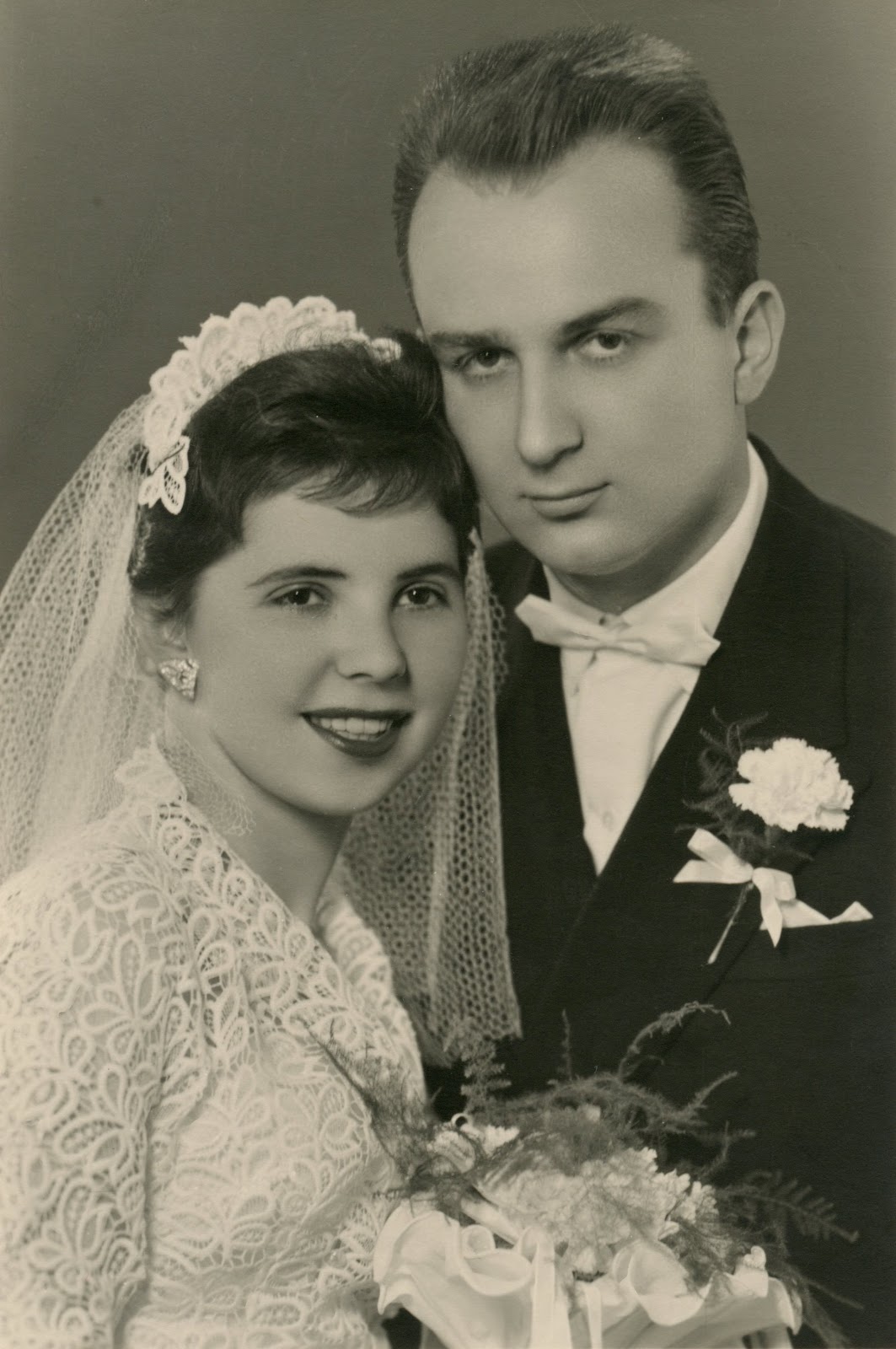
 George Mesko's wedding photo, 1960

George Mesko, a medical doctor raised in the Catholic church, resisted the establishment in communist Czechoslovakia simply by choosing to get married in the Catholic church, and by having his children baptized in secret. According to him, “in secret” meant traveling to Budapest in the case of his wedding, or to a small town in the countryside in the case of his children's baptisms, finding the church and knocking the priest's door, then having the priest perform the ceremony with the priest's  housekeeper acting as godmother. As a student living in a Catholic boys' dormitory in 1950, Mesko witnessed first-hand the infamous raids on nunneries and monasteries, where thousands of nuns, monks and priests were imprisoned or sent to labor and internment camps.  In his own dormitory, Mesko said two priests, a brother and the nuns were removed over a period of two to three years, and he described the dorms as gradually being “infiltrated” by “Martians,” his term for both communists and girls. He said some of the clergy chose to assimilate to the communist party and its views in the interest of self-preservation, in the same vein as Havel's green grocer, who decides to display a “Workers of the World, Unite!” slogan in his window to protect himself within the system.  But Mesko had very little respect for those clergymen, and he claimed that students did not listen to them because of their communist sympathies. Like Jozef Mikula and Helena Fabry, Mesko was a communist resistor. Instead of working for the CIA or passing along secret messages, however, Mesko's resistance was comprised of the simple and seemingly unassuming acts of having a church wedding and having his children baptized. By displaying his individuality and belief in something outside of a system that allowed for neither individuality nor allegiance to groups or organizations outside of itself, Mesko was as much a resistor and a perceived threat to the system as Helena Fabry.

Although it placed him outside of the established system, which at that time provided sustantial benefits for those who would simply play the game, Mesko pursued his religion because it was an integral part of his individual identity. To give that up would be to give up an important part of himself. “It's difficult to say, but when you're growing up with this heritage and you see the morality which originally comes with that, you know, it's part of your ego that you are trying to be a decent human being,” Mesko said of his Catholic background. “I'm not saying that who(ever) is not a church-goer is not a moral person, … but I felt that it's kind of very important that we stay with our tradition.”

From the oral histories cited in this paper, one can see that individual Czechs and Slovaks had many reasons, and many methods of resistance to the “post-totalitarian” regime. In a political ideology that denied individuality, the very expression of that individuality became, in Havel's eyes, one of the primary means of resistance.  From the interviews of Susan Mikula, Helena Fabry, and George Mesko, one can see that for each of them, the means of resistance were highly individual. For Jozef Mikula, it was political and public. For Helena Fabry, it was ideological and subversive, and for George Mesko, it was personal and private. Each individual, especially Fabry and Mesko, seemed to start down the path of resistance with a value (such as truth or tradition) that they deemed to be more important than the ideology of communism, and which, to them, superseded the social pull to conform. If placed in a political environment that would have tolerated extra-political values and loyalties, their actions do not seem revolutionary or clandestine. In a system that aimed to “subordinate society to the state, ” however, even simple acts of free expression and individuality became genuine threats to the regime. Just as Havel's green grocer, who, by refusing to display the party slogan in his window, refused to play into the facade, and by so doing, undermined the very core of the regime's legitimacy.

- The National Czech & Slovak Museum & Library would like to thank Utah State University, and specifically Dr. Shawn Clybor, for making this project possible.

Wednesday, April 11, 2012

Women in the Workplace in Communist Czechoslovakia


Jana Svehlova at TESLA, late 1950s

In the second of a series of posts, Recording Voices & Documenting Memories continues to showcase the work of history students at Utah State University who used NCSML oral histories to write research papers for their Eastern Europe Since 1500 class.

For her paper, Rochelle Brockman chose the theme of Women in the Workplace in Communist Czechoslovakia:

“In the party-controlled magazines for women… they are instructed to be good workers and party members first...-- never themselves?” While the author of this statement was Slavenka Drakulić from the former Yugoslavia, this statement nevertheless accurately depicts the Western perception of communist femininity. Westerners typically consider the “de-feminized” women of formerly communist countries in Eastern Europe-- in this paper, specifically Czechoslovakia-- to be the brainwashed victims of Moscow: that communism stripped them of their femininity and thus their individualism. The simple question of whether or not some women might have gained satisfaction in their traditionally masculine employment is rarely posed. In interviews with women from the former Czechoslovakia who immigrated to the United States, the nostalgia for the jobs and job opportunities they had under communism versus the jobs and opportunities they found in America was almost palpable. The remainder of this paper will explore this nostalgia and its causes through the discussion of secondary analysis of Czechoslovak law and statistics, as well as interviews with the women themselves.

Officially, communism advocated gender equality. This ideal can be clearly seen in the Czechoslovak Constitution of 1960 which asserted that “equal status of women should be secured by the development of facilities and services which will enable women to participate fully in the life of society.” At least superficially, this aim was in some ways accomplished. In 1954 only 54 percent of Eastern European women were employed. By 1970, this number had escalated to 85 percent. Female enrollment in secondary schools leapt by 114 percent between 1954 and 1965, while male enrollment increased by only 14 percent. While women’s employment rates sky rocketed during the first few decades of communist rule, did they truly want to work or enjoy it? Or are these statistics the simple result of legislation that required all adult citizens to work? For the answers to these questions we must turn to interviews with Czechoslovak women who were employed during communist rule.


Vera Plesek drives a forklift truck, Czechoslovakia, 1960s

Vera Plesek was born in 1949 in what is today the north eastern region of the Czech Republic. She began working at a road equipment factory when she was in the ninth grade. While there she learned how to paint cars and how to weld and bend metal. She then became a crane operator and fork lift driver when she was 18. When asked if she liked her job there, she enthusiastically replied “I loved it there. I used to run to work every day.” She expressed no sense that she felt deprived of a normal childhood or education by beginning to work so early. She went so far as say those nine years of Czech education were the academic equivalent of a bachelor’s degree in the U.S. She referred to her education as being “very solid” before she began working at the factory. She then compared young people in Czechoslovakia to young people in the U.S. She said that Czech young people were more responsible, less sheltered, and did fewer drugs than their American counterparts. Whether or not these assertions were true is irrelevant, they simply illustrated that Plesek did not perceive life in America to be unequivocally better than life in communist Czechoslovakia. It should be clarified, however, that Plesek was nostalgic for life in Czechoslovakia before the Soviets invaded in 1968. She referred to her life as normal under Czechoslovakian communism. Though this normalcy did not extend through the post-1968 era of normalization, Plesek said she did not resist because she did not think it would change her circumstances.

She immigrated the following year, 1969, to the U.S. because of some legal trouble in Czechoslovakia. When she first arrived in America, the second-generation Czech family that sponsored her helped her get a job in a radio factory. This stint in a typically masculine American job did not last long, however. Plesek was fired just three weeks after she was hired. In the interview, which occurred nearly 40 years later, she still expressed shock that in America one could be fired so arbitrarily. She said there were nearly 2,500 workers in that factory and that she was the first one to be terminated despite the fact that she was a good worker. She then compared this experience to her memory of communist Czechoslovakia. She said that there, no one was fired but just demoted so that one was never unemployed. This difference may have been created in part because unemployment was illegal in Czechoslovakia, and there were penalties for being unemployed. This risk of penalization might have made managers more hesitant to fire hard working employees, even if it was not economical to keep them on the payroll. In a capitalist country like America, unemployment-- while inconvenient and often times tragic-- is not illegal. Therefore, employers might have been less reluctant to let workers go if it meant an increase in profit. However, to a woman like Plesek-- whose ability to stay in the U.S. was contingent on being employed-- this type of attitude may have been perceived as inhumane.

Plesek later attempted to get a job as a crane operator. When she told the employment officers in Iowa that she was trained as a crane operator in Czechoslovakia, they laughed at her. In a pre-Betty Friedan America, the idea of a woman working in such a masculine role would have seemed absurd. Plesek did eventually find employment, but now instead of working as welder or crane operator, she worked in a more acceptably domestic domain as a dishwasher in a hospital. While she worked as a dishwasher, Plesek was not satisfied with participating solely in the domestic activities 1960s America relegated her to. She continued to maintain some of her more masculine hobbies, like repairing cars. She was extremely proud of these hobbies and even said “I always did a man’s work and I loved it.”


Helena Fabry in Bethesda, MD, 2011

Another Czech immigrant, Helena Fabry, expressed a similar though less obvious sense of nostalgia for the job opportunities available for women in communist Czechoslovakia. Fabry was born in 1925 in north eastern Czechoslovakia. She was educated and studied English in school after the end of WWII. In the late 1940s she got a job as a reporter in Prague covering city life and art events. She said of this job “it was wonderful, I loved it. I was on top of the world” : a sentiment she never expressed about the jobs she held in America. Soon afterward she was made a regional reporter for a small provincial town. While there she began to write exposés on the unethical criminal justice system that existed under the communist government. For this criticism she was expelled from the journalistic society of Czechoslovakia, which like all other organizations was communist run. As was discussed above with Vera Plesek, Fabry was not fired from the newspaper but was demoted to doing errand work. It is important to point out that Fabry was not nostalgic for the working conditions communism created--she continued to berate communism, for as she called it “its abuse of power,” for the rest of the interview. She did, however, enjoy the more egalitarian opportunity communism created for an educated woman like herself to enter a traditionally male dominated field.

Her opportunities changed in 1950 when she and her husband immigrated to the United States. Shortly after their arrival, she and her husband got jobs-- she as a cook and he as chauffeur-- at the summer home of a friend of the former Czechoslovak ambassador to the U.S. While Fabry expressed nothing on camera but gratitude for the job she had, it would not take a large leap of the imagination to suggest she may have missed the intellectual rigor that her profession in communist Czechoslovakia provided her. Even after she and her husband found more permanent employment, Fabry continued to work traditionally feminine jobs while her husband--of similar educational and linguistic background-- became economically successful and attained an advanced professional position quickly. In 1951, her husband applied for a civilian job with the U.S. Army. Because of his linguistic background he was assigned to work in an off shore procurement unit in Germany. While her husband was handling matters of international trade, she became a typist -- although she too could speak German. After she and her husband returned to the United States in the late 1950s her husband began working for Sears and eventually became the chairman of its foreign buying department. During this time she worked as a librarian in a design factory and focused on raising their son, who was born in 1960. She said “he (her husband) worked very hard but he was very successful. America was very good to us.” It is interesting to note that while Fabry had a similar level of education and worked as hard as her husband, American tradition and custom allowed only her husband to become very successful professionally. Had she stayed in Czechoslovakia, she would have-- at least theoretically-- had similar opportunities to excel professionally so long as she did not engage in politically subversive activities.

America afforded women like Vera and Helena fewer professional options than Czechoslovakia, and some of the immigrants expressed nostalgia for their former opportunities. These facts, however, do not mean that communism was some sort of feminist paradise. The Czechoslovak Constitution of 1960 may have formally professed that the “equal status of women should be secured by the development of facilities and services which will enable women to participate fully in the life of society,” but this does not mean completely equal status was the reality. Traditional domestic roles were not abandoned in Czechoslovakia simply because communism became popular. In addition to their employment outside the home, women on average spent nearly six hours a day doing house work while “husbands refused to share in work regarded as undignified.” While women’s participation in the work force may have increased at an unprecedented rate, they still only held five percent of managerial positions and made 30 percent less than their male counterparts in 1970: a dismal amount of progress seeing that the governments that professed such commitment to equality had been in power for over two decades.