Showing posts with label Museum. Show all posts

Monday, November 5, 2012

Preview of Remembering World War II

The Czechoslovak Division of the British Army in Prague, May 1945


On Veterans’ Day (Sunday, November 11 at 2:00pm), the NCSML’s oral history team, Rosie Johnston and Katie Shaffer, will show clips at the museum in which interviewees reflect upon their experiences of World War II. There are dozens of hours of footage on this subject housed at the National Czech & Slovak Museum & Library.

Here are a few clips which touch upon the topic, and which offer a preview of the sorts of videos you’ll see at the NCSML on Sunday:

Alex Cech was a teenager during WWII. He has some fond memories of wartime:


Likewise, Helena Fabry’s youth was spent in the Protectorate of Bohemia and Moravia. In this clip from her interview, she remembers one of her hobbies during the War:


Poster for a play in which Helena Fabry starred. At the bottom it states 'No Jews Allowed.'


Robert Budway was born in the United States. He moved with his mother to her native Czechoslovakia in 1931. He says his American citizenship became a problem following the assassination of Reichsprotektor Reinhard Heydrich in 1942:


These clips give you a taster of what to expect on Sunday. For more information, click here for a preview of the event in The Cedar Rapids Gazette. And, of course, come to the NCSML (1400 Inspiration Place SW, Cedar Rapids 52404) at 2:00pm on Sunday!

Monday, October 29, 2012

Cedar Rapids Humanities Iowa event, November 11


In the last in its series of Humanities Iowa events, the National Czech & Slovak Museum & Library (NCSML) is presenting clips from its oral history project in Cedar Rapids on November 11.

The event, titled Remembering World War II, will see oral history project staff Rosie Johnston and Katie Shaffer show footage presenting Slovaks' and Czechs' memories of World War II. Clips will highlight the stories of those who spent the War in hiding, as well as those who encountered American, Soviet and German troops. The discussion will be moderated by Dr. Margaret Haupt, professor emerita of political science at Coe College.

The event will take place at the NCSML (1400 Inspiration Place SW, Cedar Rapids IA 52404) at 2:00 p.m. It is free and open to the public. There is no need to RSVP.

Thursday, September 27, 2012

Humanities Iowa event in Des Moines, October 17


The NCSML is opening its oral history traveling exhibit, Leaving Czechoslovakia, in Des Moines Public Library Central Branch on Wednesday, October 17. 

At the opening, speakers will include Dr. Kieran Williams (Drake University), Dr. Mila Saskova-Pierce (University of Nebraska - Lincoln), Dr. Igor Tchoukarine (Macalester College) and Recording Voices & Documenting Memories interviewee Peter Vodenka.

The opening will run from 6:00pm - 8:00pm. It is free and open to the public. Leaving Czechoslovakia will remain on display at Des Moines Public Library until October 31. 

Please RSVP to Rosie Johnston by October 12 at rjohnston@ncsml.org. 

The event is co-sponsored by the Iowa International Center and Des Moines Public Library. It is made possible by a grant from Humanities Iowa, an affiliate of the National Endowment for the Humanities.

Monday, July 2, 2012

Leaving Czechoslovakia Exhibit in New York City


On June 27, The National Czech & Slovak Museum & Library unveiled its oral history exhibit, Leaving Czechoslovakia, in New York City. The exhibit is at the Bohemian National Hall, 321 E 73rd Street, where it will be open to the public until July 11.


The exhibit is on display on the third floor of the Bohemian National Hall, from Monday to Friday, between 12pm and 5pm. If you are interested in watching a DVD of interview clips which accompanies the exhibit, please call (212) 988-1733 to schedule in advance.

Thursday, April 5, 2012

Resistance Against Communism in Czechoslovakia


Photo of the Masin brothers, California, 1980s

In the first of a series of posts, Recording Voices & Documenting Memories is showcasing the work of history students at Utah State University who used NCSML oral histories to write research papers for their Eastern Europe Since 1500 class. Topics covered ranged from gender studies to dissent and activism in Czechoslovakia during the Cold War era.

For her paper, Tess Murray chose the theme of Resistance Against Communism in Czechoslovakia:

In this essay I will argue that all acts of resistance against the Communist regime in Czechoslovakia were effective to a degree. I will first discuss how the communists were able to seize power in Czechoslovakia. I will then examine what I believe to be the definition of resistance. I will then explore the effectiveness of the extraordinary acts of resistance performed by ordinary men such as Josef Masin, Radek Masin, and Karel Ruml.

When thinking of a seizure of power, people tend to think of it in terms of either a violent revolution or a foreign government imposing itself on the locals. In places such as Poland, the Red Army was in fact needed to enforce communism. This was not the case in Czechoslovakia. The Communist Party in Czechoslovakia came to power through their own efforts. The Communist party was one of the most organized political parties at the time and it had plenty of training and resources at its disposal. They were able to undermine any non-communist party. They did this by rewarding communist sympathizers within the other parties. Communism was also extremely popular because it was seen as a system that was the antithesis of the Nazi establishment. Communism became even more popular as it promoted the displacement of anyone seen as a Nazi collaborator. By 1947 communists had gained thirty-eight percent of the vote in Czechoslovakia. The vote reached roughly fifty percent when including the vote of social democrats. Many of the people in Czechoslovakia believed in the ideology of communism so deeply that they were willing to overlook its failures and inconsistencies. This is shown by a statement made by the Czechoslovakian communist supporter Rudolf Margolius. He said, “I cannot give up my conviction that my ideal is essentially sound and good, just as I cannot explain why it has failed---as it apparently has.” Communism did not come to power in Czechoslovakia by force, it was chosen by the people.

With every system there is going to be some form of resistance regardless of how popular it is. But what exactly defines effective resistance? I believe the words of Vaclav Havel describe resistance very well, “...individuals who were willing to live within the truth, even when things were at their worst.” This is the core of every form of resistance. Men and women are resisting when they are willing to realize the lie they are living in and call it what it really is. The mere act of being aware of the facade makes it crumble. By taking any action against a defective system it can be exposed as a fake. This leads to the system being further examined which in turn causes it to become more vulnerable to further resistance. In the case of the communist regime in Czechoslovakia, any action that caused people to question the validity of the regime was effective resistance. While a single act on its own may have not brought about the downfall of communism, it was by little actions that the seeds of further resistance were sown. Essentially, effective resistance is anything that reveals a broken system for what it really is.


Josef Masin, Germany, 1964

A man who effectively resisted communism in Czechoslovakia was Josef Masin. He became a part of an underground resistance group at a young age. When stating why he did it he said, “We fought, we wanted to fight for something, for Czechoslovakia.” Josef helped obtain weapons that would assist them in leaving the country. He also helped his group steal 850,000 crowns. They disguised themselves in militia uniforms and car jacked a van that was carrying money from a factory that made tractor parts. They used this money to fund further acts of resistance. He successfully escaped from Czechoslovakia with four other men to Berlin, causing an extensive man hunt to occur. No matter how many times he was imprisoned or tortured he would still continue to look for little ways in which he could resist a regime that he did not agree with. While his actions within the group did not bring down communism itself it exposed the cracks in its foundation.


Radek Masin, circa 1960

Radek Masin also resisted against communism in Czechoslovakia. He was continually planning ways to sabotage the communist regime. He tried to get in the army to attack it from within. When that did not work he planned to make it to the west and receive training there. While in the midst of a plan to leave the country he was caught. This led to his arrest and eventual conviction in a farcical trial. He was imprisoned for over two years and forced to work in a uranium mine. Even while working in the camp as a prisoner he was plotting ways to steal explosives to use in resistance activities. He tried to get information by borrowing books on explosives from the prison library. He also participated in other acts of resistance such as burning large amounts of straw. He felt this was a triumph not only because they destroyed so much, but because of the psychological impact it had. While this was never reported by the press, this little act caused quite a stir as it got passed through the grapevine. The effect of this action was that it caused people to start talking. And when people start talking they start to question. He knew that it was the little stuff that worked. He himself said, “We did not have any grandiose plans, you know, like ‘Oh we are going to overthrow the regime.’ That was quite obvious that you cannot do it. You just have to do whatever you can do. Even if it is small stuff.” These little actions were effective because they put the people collaborating with the regime on edge. It was also effective because it started conversations that needed to be had about what was really happening within the Communist regime.


Karel Ruml, 1949

Another man that helped resist communism was Karel Ruml. He had come to a disturbing conclusion about communism. After seeing prisoners in a work camp he said, “It sort of dawned on me then, that in a communist society people who were not healthy and capable of physical labor for the state were not expected to live very long.” A small way in which Karel resisted was by delivering mail that contained microfilm to certain locations. He also sent and received coded messages via the phone or postcards. Karel also resisted by participating in an act later named by the western press as “the freedom train”. During this act his job was to protect the hand brake on a train. He was to fend off any person who tried to stop the train. They were able to hurtle this train and its passengers safely into Germany. There were students on the train that made the choice to not go back to Czechoslovakia. His act of resistance enabled them to have this choice. This act of resistance was effective because it was highly publicized. It gave people back in Czechoslovakia an example to follow. It may have made people who were blinded by the ideology of communism stop a moment and ponder what communism was leading people to do.

Effective resistance makes people examine the world around them. Every act that was performed by these men promoted people living in a lie to do just that. By making people begin to probe the limits of their world, it can be argued that those small acts of resistance were successful. All that is necessary for change to begin to happen is an honest conversation. When actions or words lead to this type of conversation they most certainly should be deemed effective. No these acts of resistance in and of themselves did not bring about the fall of communism. But they were most certainly a catalyst. This ultimately means that any single act or any single person can create an environment in which great and often seemingly impossible things can occur. Small measures may seem insignificant to some but just look at the impact these men had. The point being, if a person wants change, the first thing they must do is be candid with themselves about the world around them. This will allow them to begin living in truth. Change will surely follow.

Thursday, March 29, 2012

American Sokol Headquarters, Brookfield


Chicagoland Sokol poster, date unknown

American Sokol was founded in St. Louis in 1865. Today, its headquarters are in Brookfield, Illinois.


Jean Hruby, American Sokol Headquarters, March 2012

Jean Hruby is American Sokol’s business manager. She says the organization is a non-political, non-religious, nonprofit active across the United States – particularly throughout the Midwest, on the East Coast and in Texas.


Bust of Sokol founder Miroslav Tyrš, American Sokol Headquarters

Czech patriot Miroslav Tyrš founded the Sokol movement in the Czech lands in 1862. According to Jean Hruby, American Sokol stays true to his principles to this day; Sokol members adhere to Tyrš’s credo of ‘a sound mind in a sound body’ through attending Sokol fitness, gymnastics (and even Zumba) classes, and cultural events put on by the organization.


'Anthem Etiquette' on the cover of American Sokol's newsletter, October 2011

Patriotism plays an important role in the Sokol ideology. Many of the organization’s members are both patriotic Czechs and Americans.


Artifacts (including a Czech governmental Gratias Agit award) and yearbooks on display at American Sokol

The headquarters of American Sokol in Brookfield double up as a library and archive housing the history of the organization. Researchers can visit the collections by making an appointment.


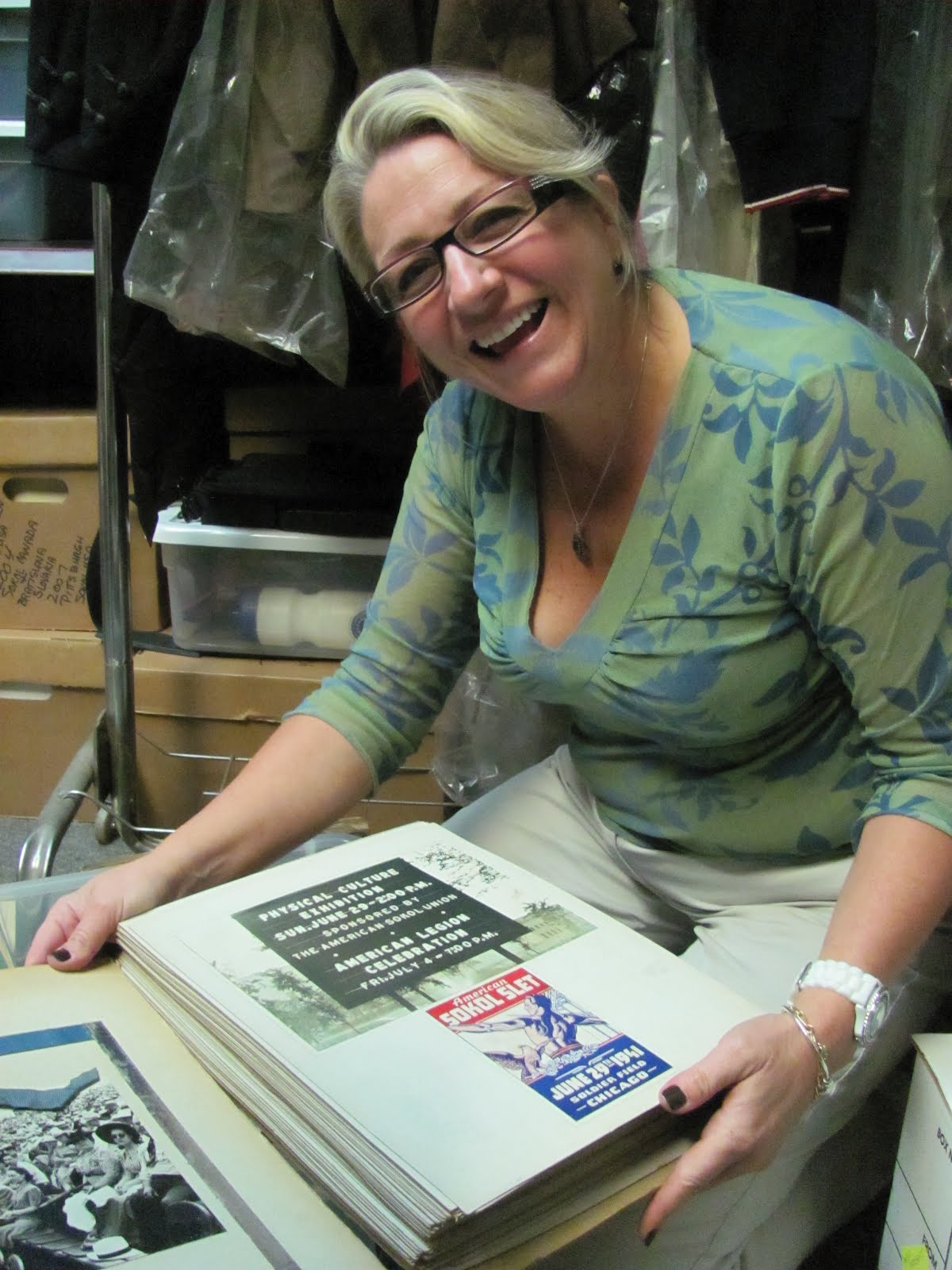
Above: Jean Hruby with a photo album from a Sokol slet at Chicago's Soldier Field, below: a photo from the album showing slet participants, 1941

The archives are particularly rich in photos and other documentation of previous Sokol slets – mass gymnastics festivals at which thousands of Sokol members perform synchronized gymnastics routines.


Photo from the Prague Sokol slet of 1948

For more information on American Sokol and the organization’s library and archives, visit www.american-sokol.org.

Wednesday, November 23, 2011

The Slovak Canadian Heritage Museum in Oshawa, November 2011


The Slovak Canadian Heritage Museum (SCHM) opened in Oshawa in 2010 with the aim of making audiences ‘aware of Slovak heritage in Canada through the exhibition of heritage artifacts.’ The museum (which had previously been located in Markham, a town to the West of Toronto with a long history of Slovak settlement) opened in Oshawa in a former furniture store, originally belonging to a Mr Michna, a Slovak immigrant who came to Canada in 1924. Of the new location (about 30 minutes to the East of Toronto), museum director Margaret Dvorsky says “it’s a good place to start, the city fathers are happy we are here.”


Museum president Margaret Dvorsky and Jaromir Lukac at the SCHM


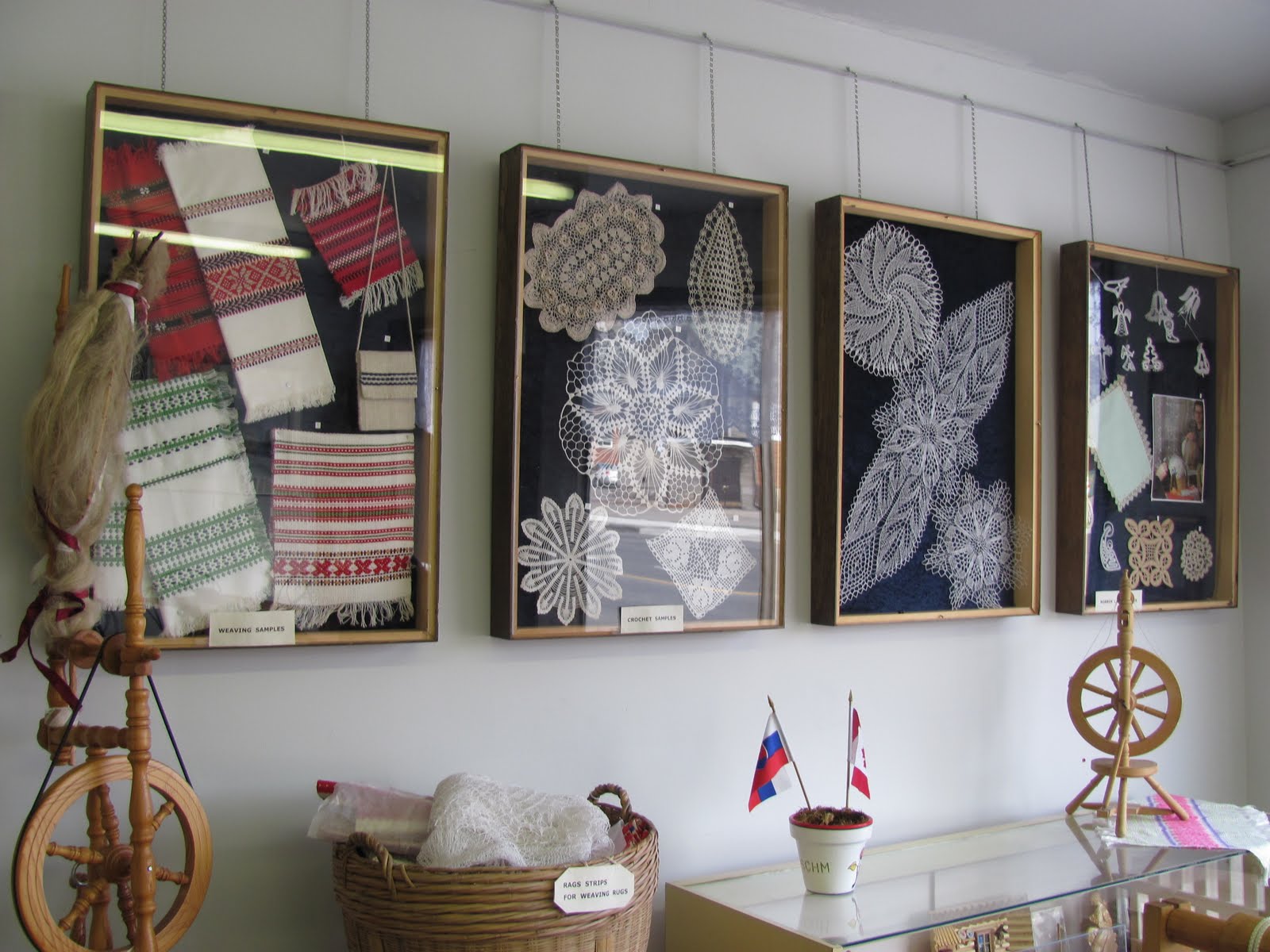
Visitors to the museum can try their hand at weaving and a number of other traditional needle crafts. On display are items of bobbin lace, embroidered folk costumes (kroje) and fabrics which have been traditionally printed using wax and indigo dye.


Some of the textiles on display at the SCHM

As well as running the museum itself, Margaret, Jaromir, and other members of the SCHM committee organize an annual Slovak Heritage Festival. They packed Recording Voices & Documenting Memories off with a copy of the very first program for the Slovak Heritage Festival in 2004, which included a bilingual Slovak-English map of the festival site in Markham, ON:


Extracts from the first Slovak Heritage Festival program, 2004

More information about the Slovak Canadian Heritage Museum (including a number of particularly lovely photo galleries) can be found on the organization’s website, at http://www.schm.ca/. The museum is staffed by a corps of volunteers and open from Tuesday through Sunday at 485 Ritson Road, Oshawa, Ontario L1H 5K1.

Thursday, October 6, 2011

The Carpatho-Rusyn Heritage Museum in Parma, Ohio


Trophy awarded as first prize at Cleveland Rusin Day, 1923

This is something of a historic blog post now that the Carpatho-Rusyn Heritage Museum is no longer situated in St. John the Baptist Cathedral in Parma, Ohio. Nonetheless, here are a number of photos taken during a visit to the museum in the Spring of 2010 alongside some information about the Carpatho-Rusyns gleaned in the course of that visit. For more on the Carpatho-Rusyn Heritage Museum - which is in the process of relocating - visit the organization’s website and another great resource is the Carpatho-Rusyn Society’s blog.


Interpretation board at the Carpatho-Rusyn Museum, Parma

Entering the museum, visitors are greeted by a description of who exactly the Carpatho-Rusyns are. An extract from the text on the sign pictured above reads:

“Carpatho-Rusyns are linguistically and culturally an East Slavic people who settled along the northern and southern slopes of the Carpathian Mountains. Their homeland is situated in the area where Slovakia, Ukraine, and Poland meet. Aside from those countries, there are smaller numbers of Carpatho-Rusyns in parts of Romania, Hungary, the Czech Republic, Croatia, and Serbia.”


Map and flag from the Carpatho-Rusyn Museum, Parma

The museum’s website describes the institution’s holding as follows:

“The collection of artifacts includes historical costumes, photographs, documents, maps, folk art, needlework, videos, music and recordings, and a library.”

When Recording Voices & Documenting Memories visited the museum there was a special, seasonal, focus on pysanky (kraslice – painted eggs) and traditional foods prepared at Easter time by the Carpatho-Rusyns.


Pysanky (painted eggs) at different stages of completion, Carpatho-Rusyn Museum

The role of museum guide was played by Maryann Sivak, who came to America from Czechoslovakia in 1968 and co-founded the Carpatho-Rusyn Society here a quarter of a century later. In this clip from her interview with Recording Voices & Documenting Memories, she recalls the difficulty authorities had recognizing her Carpatho-Rusyn ethnicity growing up:


For more on Carpatho-Rusyn culture and news on meetings and events taking place here in the United States, visit the links posted above and the Carpatho-Rusyn Society’s website (http://c-rs.org/).