Showing posts with label Chicago. Show all posts

Thursday, July 19, 2012

T G Masaryk Czech School, Cicero, IL

The Tomas Garrigue Masaryk School in Cicero, Illinois was founded in 1921:

Facade of the T G Masaryk Czech School, Cicero, IL

Trilingual reserved parking sign at the TGM School
Detail from the facade of the TGM School

To this day, it provides a space for both children and adults from the Chicagoland Area to come and learn the Czech language.


The school takes its name from the first Czechoslovak president, Tomas Garrigue Masaryk. To celebrate his birthday on March 7, some of the school’s students decorated the classrooms with scenes from his life:


Drawing of Tomas Garrigue Masaryk as a particularly muscular blacksmith

The school also has a comprehensive library, and is home to a number of local Czech and Slovak organizations:


During the summer, children can attend Czech-language summer school. On Wednesdays, Czech-American Pavlina Parks runs a music class for toddlers:


Pavlina Parks at the TGM School

The school has a large garden, in which pupils grow vegetables and where they can play:


School caretaker Sharon in the TGM playground

In her interview with Recording Voices & Documenting Memories, teacher Irena Cajkova discussed her involvement with the T G Masaryk School:


For more information on the T G Masaryk Czech School, visit the organization’s Facebook page or call (708) 656-9810.

Tuesday, May 15, 2012

Leaving Czechoslovakia Exhibit Opening in Oak Park


On Friday, May 11, the National Czech & Slovak Museum & Library (NCSML) unveiled its oral history exhibit Leaving Czechoslovakia at Oak Park Public Library in Illinois. The exhibit draws upon the first two years’ worth of interviews gathered through Recording Voices & Documenting Memories, and focuses on Cold War-era Czech & Slovak immigration to the United States.


The exhibit runs until May 27 in the library’s ‘Idea Box.’ It is free and open to the public.

Library Director Deirdre Brennan (left) with board members David Sokol and Mila Tellez

Slovak Honorary Consul Rosemary Macko Wisnosky

 Consul General of the Czech Republic in Chicago Dana Hunatova

At the exhibit opening, speeches were given by members of Oak Park Public Library’s board with a Czech connection, Mila Tellez and David Sokol. The Consul General of the Czech Republic in Chicago, Dana Hunatova, and the Slovak Honorary Consul Rosemary Macko Wisnosky also spoke.


Patriotic Slovak and Czech cupcakes were provided by the NCSML Guild. They proved to be something of a fashion statement:


Click here for more information about Leaving Czechoslovakia at Oak Park Public Library.

Wednesday, May 2, 2012

Leaving Czechoslovakia Exhibit Preview


Since January 2012, the Recording Voices & Documenting Memories team has been working to assemble a traveling exhibit which presents some of the highlights of the oral history project so far.

The exhibit, Leaving Czechoslovakia, will debut at Oak Park Public Library on May 11, 2012. It will run until May 27.

The exhibit focuses on Cold War-era Czech & Slovak immigration to the United States, and is split into three sections: the first presents some of the reasons why Czechs and Slovaks emigrated, the second deals with how Czechs and Slovaks made it to the United States and the third looks at what happened next.

The exhibit consists of display panels with photographs and quotes, and a DVD in which 20th-century Czech & Slovak émigrés to America present their stories in their own words.

Here are a couple of the clips you will see in the second section of the exhibit, in which interviewees discuss how they left Czechoslovakia:

Karel Ruml was raised in Nymburk, Bohemia. In 1951, he and a group of accomplices hijacked a train in order to cross the border into West Germany:


Jiri Pehe, meanwhile, left Czechoslovakia with his wife in 1981. The pair traveled to Yugoslavia, where they succeeded in persuading two Austrian tourists to help them across the border into Austria:


The opening reception for Leaving Czechoslovakia will be held at Oak Park Public Library on May 11 at 7pm. It is free and open to the public, though guests are asked to RSVP to Leah Wilson (lwilson@ncsml.org) by May 9. The exhibit will run until May 27 and then go on display in New York City in June. 

Thursday, March 29, 2012

American Sokol Headquarters, Brookfield


Chicagoland Sokol poster, date unknown

American Sokol was founded in St. Louis in 1865. Today, its headquarters are in Brookfield, Illinois.


Jean Hruby, American Sokol Headquarters, March 2012

Jean Hruby is American Sokol’s business manager. She says the organization is a non-political, non-religious, nonprofit active across the United States – particularly throughout the Midwest, on the East Coast and in Texas.


Bust of Sokol founder Miroslav Tyrš, American Sokol Headquarters

Czech patriot Miroslav Tyrš founded the Sokol movement in the Czech lands in 1862. According to Jean Hruby, American Sokol stays true to his principles to this day; Sokol members adhere to Tyrš’s credo of ‘a sound mind in a sound body’ through attending Sokol fitness, gymnastics (and even Zumba) classes, and cultural events put on by the organization.


'Anthem Etiquette' on the cover of American Sokol's newsletter, October 2011

Patriotism plays an important role in the Sokol ideology. Many of the organization’s members are both patriotic Czechs and Americans.


Artifacts (including a Czech governmental Gratias Agit award) and yearbooks on display at American Sokol

The headquarters of American Sokol in Brookfield double up as a library and archive housing the history of the organization. Researchers can visit the collections by making an appointment.


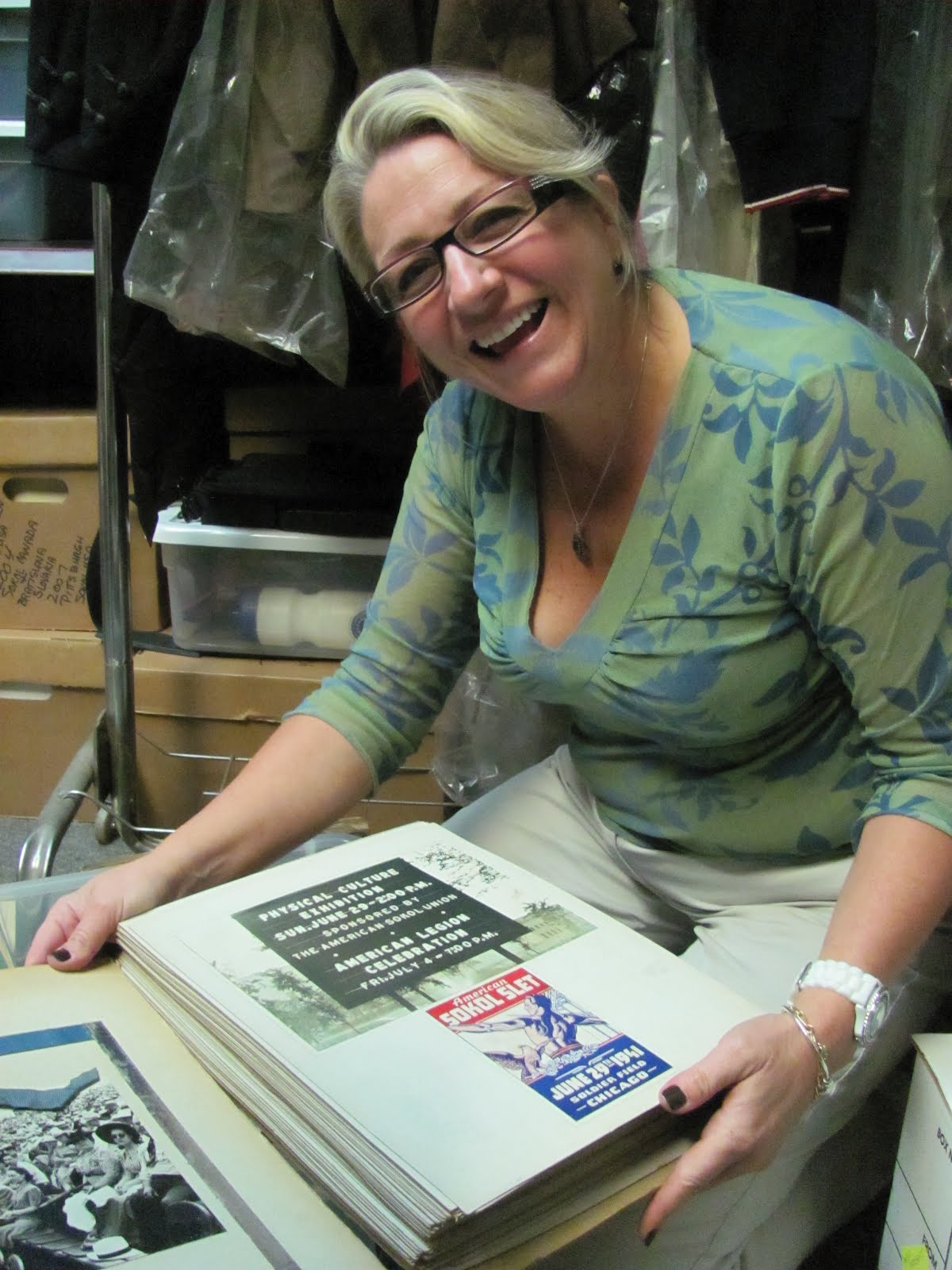
Above: Jean Hruby with a photo album from a Sokol slet at Chicago's Soldier Field, below: a photo from the album showing slet participants, 1941

The archives are particularly rich in photos and other documentation of previous Sokol slets – mass gymnastics festivals at which thousands of Sokol members perform synchronized gymnastics routines.


Photo from the Prague Sokol slet of 1948

For more information on American Sokol and the organization’s library and archives, visit www.american-sokol.org.

Tuesday, February 14, 2012

Interviewee Vladimir Krman In His Own Words

It is rare that we have an article in Slovak or Czech on this Recording Voices & Documenting Memories blog. But happily, that is just one of the things that this blog provides a platform for – especially when it is one of our interviewees who is the author:


Fred Tornil/ Vladimir Krman in Air Force uniform, 1949

Fred Tornil (aka Vladimir Krman) spoke to Recording Voices & Documenting Memories in January 2011. He recently contacted the NCSML to say that interest in Slovakia had led him to translate his profile into his mother tongue. In his correspondence with the museum he wrote:

“I sat down and spent a few evenings doing this literary ‘assignment’. I did modify some small details, but basically it is a "loose" translation of the original. I don't have a Slovak keyboard, so I typed it without the customary diacritics. People in the old country have no problem reading it…”

So here you have it, Fred Tornil in his own words, in his own tongue:

Vladimir Krman sa narodil roku 1929 v Bratislave. Tam studoval na Obchodnej akademii, lebo rodicia chceli, aby sa stal bankovym uradnikom, ale so studiom neskor skoncil a v 1948 vstupil k vojenskemu letectvu. Lietat zacal v 1946 roku v bratislavskom aeroklube na Dubravke a vo Vajnoroch. Ziskal niekolko kategorii uznania v plachtarstve i v parasutisme. Po absolvovani vojenskeho vycviku ako catar, neskor rotny a starsina, bol zaradeny do vycviku vojenskych pilotov v Piestanoch a na Troch Duboch pri Zvolene. Postupom casu bol podla sovietskeho vzoru povyseny na podporucika, potom na porucika. Ilegalne opustil Ceskoslovensko zaciatkom 1953 roku, ked, ako hovori, dostal sa do nesnadzi kvoli "politickej neaktivite". Bol tiez clenom leteckej akrobatickej skupiny. Vladimir hovori, ze by bol zbaveny funkcie ucitela lietania a teda i moznosti lietat, preto sa odhodlal k uletu.

Vladimir, koncom 1952 roku, spolu s bratrancom Jozefom Fleischhackerom a ich priatelom Gustavom Molnarom vymyslel plan ako opustit Ceskoslovensko. Hovori, ze plan uteku bol planovany v tanecnej sale Reduty v Bratislave, za zvukov Americkeho slagru Domino. A tak i pomenovali ich akciu “Operacia Domino”. Bolo dohodnute, ze ked Gustav bude mat funkciu “dozorneho straze,” Vladimir a Jozef za noci vklznu do hangara a pripravia lietadlo ku startu. Potom v skorych rannych hodinach odstartuju smerom do Rakuska, kde poziadaju o “azyl”. Moznost uteku nastala v piatok 13. marca 1953 v Piestanoch. Vladimir hovori, ze plan uteku prebiehol bez chyby, az na to, ze kratko po prelete Rakuskych hranic uzreli dva Ruske Mig-15-ky. Za stalej tmy sa im ale podarilo uniknut zmenou kurzu a nizkym letom.

Tito traja bezpecne doleteli do Graza, kde po “de-briefingu” mali tlacovu konferenciu a zverejnenie ich uteku. V priebehu 10 dni sa ocitli v Londyne, kde im k voli bezpecnosti britsky hostitelia navrhli zmenu mien. Vladimir si zvolil meno Frederick Tornil, ktore pouziva dodnes. Po jedom roku v Anglii, Vladimir emigroval do Kanady. Posobil tam ako instruktor na Torontskom letisku a zaroven pracoval v General Motors v Oshawe. V 1958 pre-emigroval do Spojenych Statov a usadil sa v Chicagskej oblasti. Pracoval v Rockwell-Standard Corporation, potom v Zenith Radio & Television a konecne v General Motors EMD v La Grange, kde posobil vyse 30 rokov. Ma licenciu “Obchodneho Pilota” a lietal z letiska “DuPage County Airport”, uz len iba zalubou. Ozenil sa s jeho niekdajsiou laskou z bratislavskeho aeroklubu, Ruzenou. Za Dubcekovej ery prisla do USA so synom Romanom, (ktory neskorsie sluzil u Americkeho Vojenskeho letectva - USAF). Vladimir a Ruzena maju dvoch dalsich synov Martina a Daniela. Vladimir hovori, ze rad hraval fotbal, lyzoval a zucastnoval sa zabav v Slovenskom atletickom klube (Slovak A.A.) v Chicagu. Dnes sa venuje roznym opravam okolo domu, aut a motoriek.

Vladimirovi rodicia chceli, aby bol bankovym uradnikom a nie pilotom:

“Rodicia boli velmi proti tomu, nechceli aby som bol pilotom i napriek tomu, ze som zacal lietat uz v 1946, skoro po vojne. Vstupil som do plachtarskeho odboru aeroklubu Bratislava, dosiahol som podmienku stupna "C" a tiez jednu podmienku na strieborne "C". Popri plachteni, zacal som parasutisticky vycvik a vykonal 6 zoskokov. Mal som teda prijatelnu kvalifikaciu k vojenskemu pilotnemu vycviku.”

Vladimir spomina na podmienky u Ceskoslovenskeho letectva, kratko po 2. svetovej vojne:

“Zacinali sme s tym co zostalo po prechode fronty, teda koristny material, klzaky, vetrone a cvicne lietadla pozivane nemcami. V tych rokoch, ked sme zacinali skakat padakmi, boli to pouzite vojenske kamuflazove padaky v ktorych si mysi urobili hniezda. Museli sme napred "zaflakovat" diery, nez sme ich mohli pouzit k zoskokom z americkeho DC-3. Lietadla Dakota a Piper Cub, ktore nam boli darovane nadaciou UNRRA, (United Nations Relief and Rehabilitation Administration) bola velka pomoc v dobe nudze! Tieto mali este zelene bojove zafarbenie. Letecky vycvik u vojenskeho letectva i napriek viacerym havariam starsich lietadiel prebiehal prudkym tempom. Letecka osnova v 48-mom roku bola anglicka z Royal Air Force. Nasi instruktori boli zo zapadneho i z vychodneho frontu s bohatymi bojovymi skusenostami.”

For the full translation of Vladimir's profile, visit http://www.ncsml.org/Oral-History/Chicago/20110322/99/Krman-Vladimir.aspx.

Wednesday, December 21, 2011

Jakub Jan Ryba's Czech Christmas Mass in Chicago

On Saturday, December 17, Jakub Jan Ryba's Czech Christmas Mass was performed for the first time ever in Chicago.


The performance was organized by The Chicago Prague Sister Cities Committee, The Consulate General of the Czech Republic in Chicago and The First United Methodist Church at the Chicago Temple.

The choir singing the mass consisted of regular choristers from the Chicago Temple and individuals from Chicago's Czech community, with members of the city's United Moravian Societies particularly well represented.


United Moravians in kroj bring flowers to performers
Photo: Michal Tauvinkl

To hear how the mass sounded, and to find out more about how the audience reacted to the piece, click here to listen to a radio feature recorded at the Chicago Temple.

Monday, October 31, 2011

Czech & Slovak Family Restaurants


In the course of working on Recording Voices & Documenting Memories, food has been an important theme, and a good number of the people the National Czech & Slovak Museum & Library has spoken to have owned their own family restaurant, either here in the United States or in Europe prior to their departure.

Dusan Ciran’s stepfather, Emil Sarvady, owned a restaurant in the town of Senica, Western Slovakia, in the run up to WWII (the restaurant in question is pictured above, in more recent times). In this clip from Dusan’s interview with Recording Voices & Documenting Memories, he recalls serving German soldiers there during the War:


Robert Dobson, meanwhile, worked as a waiter (as well as a hair model) in Prague in the 1970s. When he came to Chicago with his family in 1984, he started working as a bartender in the city before buying Pilsner Restaurant in Berwyn three years later. He and his family ran the establishment for the next 13 years. In this clip from his interview, Robert remembers the most popular items on the menu:


Today, Robert runs a remodeling and construction firm based in Bolingbrook, Illinois.


Josef Tousek was a waiter and hotelier in Czechoslovakia before he came to Chicago in 1981. After working at Ciel Bleu French Restaurant in Chicago’s Mayfair Hotel for some years, he set up his own Alpine Banquet House, which now has two branches in the Greater Chicago Area. He shared photos of his restaurant on Roosevelt Road before and after reconstruction with Recording Voices & Documenting Memories:


Photos of Alpine Banquet House before and after renovation

Ales Vesely came to the United States in 1983. Today he works as a barman in Chicago’s Klas Czech Restaurant (where this photograph was taken):


Of Klas Restaurant and the neighborhood, Cicero, in which it is found, Ales says: “…It used to be all Czech over here. I remember we’d drive down Cermak Avenue and there would be Czech butcher shops, a bakery, other restaurants, Czech bars, even Polish places. And now you drive down Cermak Avenue and pretty much it’s all Spanish. This is the last Mohican on Cermak Road. I love this place, it’s very unique."

Thursday, October 20, 2011

Oral History Interviewer, Igor Mikolaska


In late 2010, Slovak-born Igor Mikolaska began working on the Recording Voices & Documenting Memories project as a field interviewer in Chicago. One year and around 30 interviews later, the NCSML asked him a couple of questions about what he had learned through his participation in the project:

“Since I started work on the oral history project I have learned to appreciate the society we live in now. I have realized that people cannot be caged in their opinions and in where they live, since they always strive for freedom. It is a universal law of life and everybody gravitates towards it.”

Which are your favorite and least favorite parts of the job?

“Recording memories that otherwise might be lost is an exciting part of the job and there is a lot to be learned from older generations. Many times I’ve found myself wondering how they were able to find the strength, courage, and amazing tolerance required to go through such a difficult process of creating a new life. On the other hand, getting to where you are actually sitting in front of that person isn’t easy. People find themselves reluctant to open closed chapters of their life, so as not to suffer again.”

Which has been your favorite interview to record and why?

“Vladimir Krman has an amazing story that could be in a Hollywood movie. Three friends meet in a dance hall in Bratislava and orchestrate an extremely difficult escape out of the country. The fact they escaped in an airplane is truly spectacular…


“...Their road to freedom was not an easy one, but I guess they took a shortcut through the sky.”

What is, in your opinion, the importance of oral history projects such as Recording Voices & Documenting Memories?

“I would have been very grateful if somebody had recorded an interview with my grandparents. The stories they told are gone with time and I am left with just a vague image of the life of my grandparents. At the time I did not think of taking a pencil and scribbling down their amazing past adventures and they are lost now. Through documenting the past we can understand better the future and can learn aspects of history that have never been told to anyone. We record stories that otherwise could be lost.”

In which ways do you hope the project develops over the next two years?

“I hope that the oral history project can be used also for educational purposes and as an inspiration to future storytellers. I hope that people will take more interest in the lives of their relatives. I hope that though the project people will also appreciate present times more since this turbulent past is behind us.”

The NCSML has just started recording the oral histories of Czechs and Slovaks, such as Igor, who came to the United States following the fall of Communism in 1989. Watch our website over the coming days to see excerpts from Igor’s interview with Recording Voices & Documenting Memories.

Wednesday, October 12, 2011

Vltava Czech & Slovak Grocery, Chicago


Vltava Czech & Slovak Grocery, W Belmont Ave., Chicago

According to its owner, Tomas Votocek, Vltava is the only shop dedicated exclusively to Czech & Slovak goods in Chicago. Mr Votocek bought the store four years ago and transformed it from a Polish grocer’s into an outlet selling Czech & Slovak food, videos, books and ceramics.


Owner Tomas Votocek behind the counter at Vltava

Vltava is located at 7416 W Belmont Avenue in Chicago and open seven days a week. Customers from further afield can order goods through the store’s Czech-language website, which will then be delivered for a shipping fee throughout the United States.


Books on sale at Vltava - featured is a cookbook from 1968 offering readers 'humorous' recipes

The store stocks a number of Czech and Slovak books and magazines. Books sold are a mixture of brand new and second hand. Earlier this week, there were a large number of cookery books in particular on sale.


Goods on sale at Vltava

Owner Tomas Votocek says he works with a local Polish baker to produce bread baked according to a Czech recipe. Mr Votocek buys perishable Czech & Slovak delicacies like šunka v aspiku (ham in aspic), ruské vejce (egg salad) and chlebíčky (open sandwiches) from a local Czech woman who makes them for him specially. The rest of the food is imported from the Czech Republic and Slovakia.


Singer Karel Gott at Vltava (photo courtesy of vltava.us)

At Vltava, customers can also send parcels, flowers or money orders to the Czech Republic or Slovakia, convert videos from European PAL into US NTSC format and even buy tickets for Czech & Slovak cultural events in Chicago. As the image above shows, Vltava acted as a ticket office for Karel Gott’s 2009 American Tour (more photos can be found online at http://www.vltava.us/gott.html).

Look out for video highlights from Recording Voices & Documenting Memories’ interview with Czech-born owner of Vltava Tomas Votocek on the NCSML’s website over the weeks to come.

-Posted by Rosie Johnston

Monday, August 15, 2011

Tramping

Tramping is a Czech and Slovak pastime which has been referred to by a number of interviewees in the course of the NCSML’s oral history project. The activity itself consists of spending time in nature and sleeping rough. Particular types of music and clothing (very often influenced by American, Wild West imagery) accompany the pastime.


Peter Vodenka at the 'Corral OK,' South Bohemia, 1980s

In his interview with Recording Voices & Documenting Memories, Peter Vodenka explains what tramping meant to him growing up in Czechoslovakia in the 1970s and 1980s:


Bob Rychlik also enjoyed tramping in Czechoslovakia in his youth:


Trempové or tramps may be, as Bob Rychlik says, ‘without leaders,’ but they are often loosely organized into osady (tramping colonies). The head of each osada is known as the ‘sheriff.’

Several tramping groups were established by Czechs and Slovaks who emigrated, amongst the most prominent of which was Chicago’s Dálava, headed by Sheriff Eda Vedral:


Eda Vedral in a '35 years of Dálava' t-shirt, Chicago

If you are interested in finding out more about tramping on both sides of the Atlantic then Jan Šikl’s film See you in Denver is an excellent, subtitled resource.

Wednesday, July 6, 2011

Slovo, Summer 2011


Cover of Slovo, Summer 2011

A new edition of the NCSML’s journal Slovo is out, and the whole issue is devoted to Recording Voices & Documenting Memories. Here are extracts from some of the articles written for Slovo by oral history project participants alongside images they shared with the NCSML at the time of their interview.


Portrait of Karel Ruml, 1949

Karel Ruml left Czechoslovakia in 1951 by “crashing a train through the Iron Curtain into West Germany.” In this edition of Slovo, he remembers his escape:

“My own task was to prevent anyone from using the single manual brake in my coach. With the train in motion… I got up and walked slowly to the end of the corridor, where I casually leaned on the wheel of the brake. Soon we were racing through As and a big, self-assured border guard tried to push me aside. I quickly drew my gun and ordered him to stop and keep quiet. He glared at me with a mixture of hate and cowardice, but didn’t move… We finally stopped among farm fields. Not too far behind us was a forested ridge bristling with watch towers and barbed wire – the Iron Curtain… Bewildered passengers [milled] outside the train.”


Birthday card designed by John Palka, circa 1950

In Twice Displaced But Not Defeated John Palka (who came to the United States in 1941 and then again in 1949) writes:

“…My parents worked hard to raise me with a dual identity – that of a devoted American grateful to his new homeland for the safety and opportunities it offered him, but also that of a Slovak who knew about and was proud of his heritage. In this they succeeded, for that is the way I still see myself today. After her death, I found in my mother’s files a memento that expresses this duality perfectly, a birthday card I made for her. On the front I wrote Happy Birthday and Št’astlivé narodzeniny, and on the back I drew two flags, the Czechoslovak above and the U.S. flag below. I was 11 or 12 when I sat down with my crayons to make this card.”


Jana Svehlova with her father, Jan Roubik, in England during WWII

Jana Svehlova is the founder of a non-governmental organization called The Enemy’s Daughters. She herself is the daughter of a political prisoner, her father having been arrested in 1949 because he was an RAF pilot during WWII and, she says, “the communist regime viewed those who had fought for the Allies with hostility.” In Slovo, Jana recollects her father’s arrest:

“The only clear image I have of that day is the color of my dad’s face when the agents were taking him away at 9 o’clock in the morning – stark white. I did ask one of the men, 'Where are you taking my daddy?' The security agent answered, 'We have to ask him some questions.' My father was arrested and sentenced to 10 years of hard labor… My mother and I were able to visit him about two times a year.”


Vladimir Maule's ID card, circa 1969

In From Lenin to Lennon, Vladimir Maule remembers his youth in Prague and journey to America in 1969. He settled with his mother in what was then a particularly Czech neighborhood of Chicago:

“As we walked along 26th Street, we heard some voices speaking in Czech. The sound was coming out of a travel agency. It was a social group of elderly Czechs at their monthly meeting, where they discussed global events and exchanged cooking recipes. They were genuinely happy to help. They found a place for us to stay the first night and recommended where to apply for work – my mom at Western Electric and I at a steel company called CECO. The next day we were both hired. (I had taken the wrong bus so ended up at Sears.) We found a basement apartment in Berwyn, a Chicago suburb with a sizable Czech population. We were on a roll.”

Vladimir talks more about the mix-up which led him to find employment at Sears (and not CECO) in this clip from his oral history interview:


Also in this edition of Slovo are articles by project participants Melania Rakytiak and Peter Hruby. Slovo is sent to all NCSML members and can be purchased at the museum store in Cedar Rapids.