Showing posts with label Parma. Show all posts

Thursday, October 6, 2011

The Carpatho-Rusyn Heritage Museum in Parma, Ohio


Trophy awarded as first prize at Cleveland Rusin Day, 1923

This is something of a historic blog post now that the Carpatho-Rusyn Heritage Museum is no longer situated in St. John the Baptist Cathedral in Parma, Ohio. Nonetheless, here are a number of photos taken during a visit to the museum in the Spring of 2010 alongside some information about the Carpatho-Rusyns gleaned in the course of that visit. For more on the Carpatho-Rusyn Heritage Museum - which is in the process of relocating - visit the organization’s website and another great resource is the Carpatho-Rusyn Society’s blog.


Interpretation board at the Carpatho-Rusyn Museum, Parma

Entering the museum, visitors are greeted by a description of who exactly the Carpatho-Rusyns are. An extract from the text on the sign pictured above reads:

“Carpatho-Rusyns are linguistically and culturally an East Slavic people who settled along the northern and southern slopes of the Carpathian Mountains. Their homeland is situated in the area where Slovakia, Ukraine, and Poland meet. Aside from those countries, there are smaller numbers of Carpatho-Rusyns in parts of Romania, Hungary, the Czech Republic, Croatia, and Serbia.”


Map and flag from the Carpatho-Rusyn Museum, Parma

The museum’s website describes the institution’s holding as follows:

“The collection of artifacts includes historical costumes, photographs, documents, maps, folk art, needlework, videos, music and recordings, and a library.”

When Recording Voices & Documenting Memories visited the museum there was a special, seasonal, focus on pysanky (kraslice – painted eggs) and traditional foods prepared at Easter time by the Carpatho-Rusyns.


Pysanky (painted eggs) at different stages of completion, Carpatho-Rusyn Museum

The role of museum guide was played by Maryann Sivak, who came to America from Czechoslovakia in 1968 and co-founded the Carpatho-Rusyn Society here a quarter of a century later. In this clip from her interview with Recording Voices & Documenting Memories, she recalls the difficulty authorities had recognizing her Carpatho-Rusyn ethnicity growing up:


For more on Carpatho-Rusyn culture and news on meetings and events taking place here in the United States, visit the links posted above and the Carpatho-Rusyn Society’s website (http://c-rs.org/).

Tuesday, July 26, 2011

Holúbky making for the Cleveland Slovak Festival, September 2010

The Cleveland Slovak Festival has been held annually over the Labor Day weekend since 1971. Last year, it took place at St. Anthony of Padua Church in Parma, Ohio. Festivalgoers enjoyed a number of accordion bands, Slovak folk dance performances, Zlatý bažant beer and hearty portions of Slovak food.

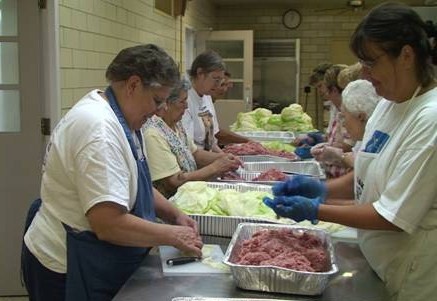
Ahead of the festival on September 4, I joined the twenty-some volunteers preparing holúbky for the festival. Holúbky (which literally means ‘pigeons’) are stuffed cabbage leaves traditionally made, according to those at the festival, in the eastern Zemplín region of Slovakia. Here’s a photo guide showing how to make the perfect stuffed cabbage leaf:


First of all, you need to boil your cabbage. This makes the individual leaves more pliable so you can wrap them easily around the stuffing later on. At the festival, the hearts of each cabbage were then used in a tomato/cabbage-based sauce served over each of the holúbky. From my understanding, this is something of an optional flourish; holúbky can be served plain as well.


This photo of a fraction of the boiled cabbage leaves piled high gives you an idea of the quantities of holúbky being made for the festival.


Next up is the stuffing: the recipe used at the Slovak festival called for pork and beef to be mixed with rice and seasoned with salt and pepper. Onions sautéed in butter were also added to the mixture and worked in, as you can see, using a good deal of elbow grease.


With the leaves and the stuffing now prepared, it was time to make the holúbky themselves. To do so, small meatballs were prepared (as shown on the front right of this picture) and then wrapped in cabbage leaves (as shown on the front left).


Finally, the end of the cabbage leaf needs to be tucked into the roll so that the filling stays firmly in place. If the cabbage leaf is too long, then Mary Lesko (pictured) suggests you should cut it down so that it fits better. The scraps of cabbage left over became part of the holúbky sauce.

At the festival, the holúbky sold like hot pigeons and I didn’t notice any left at the end of the day. According to festival founder Paul Brunovsky, who spoke to the NCSML’s Recording Voices & Documenting Memories, food and drink have proven to be a major part of the event's allure since it was founded 40 years ago:


This year, the Cleveland Slovak Festival will be held on September 4th, again at St. Anthony of Padua Church in Parma, Ohio. The NCSML will be there with information about the museum and Slovak products for sale.