Showing posts with label Berwyn. Show all posts

Wednesday, May 2, 2012

Leaving Czechoslovakia Exhibit Preview


Since January 2012, the Recording Voices & Documenting Memories team has been working to assemble a traveling exhibit which presents some of the highlights of the oral history project so far.

The exhibit, Leaving Czechoslovakia, will debut at Oak Park Public Library on May 11, 2012. It will run until May 27.

The exhibit focuses on Cold War-era Czech & Slovak immigration to the United States, and is split into three sections: the first presents some of the reasons why Czechs and Slovaks emigrated, the second deals with how Czechs and Slovaks made it to the United States and the third looks at what happened next.

The exhibit consists of display panels with photographs and quotes, and a DVD in which 20th-century Czech & Slovak émigrés to America present their stories in their own words.

Here are a couple of the clips you will see in the second section of the exhibit, in which interviewees discuss how they left Czechoslovakia:

Karel Ruml was raised in Nymburk, Bohemia. In 1951, he and a group of accomplices hijacked a train in order to cross the border into West Germany:


Jiri Pehe, meanwhile, left Czechoslovakia with his wife in 1981. The pair traveled to Yugoslavia, where they succeeded in persuading two Austrian tourists to help them across the border into Austria:


The opening reception for Leaving Czechoslovakia will be held at Oak Park Public Library on May 11 at 7pm. It is free and open to the public, though guests are asked to RSVP to Leah Wilson (lwilson@ncsml.org) by May 9. The exhibit will run until May 27 and then go on display in New York City in June. 

Thursday, March 29, 2012

American Sokol Headquarters, Brookfield


Chicagoland Sokol poster, date unknown

American Sokol was founded in St. Louis in 1865. Today, its headquarters are in Brookfield, Illinois.


Jean Hruby, American Sokol Headquarters, March 2012

Jean Hruby is American Sokol’s business manager. She says the organization is a non-political, non-religious, nonprofit active across the United States – particularly throughout the Midwest, on the East Coast and in Texas.


Bust of Sokol founder Miroslav Tyrš, American Sokol Headquarters

Czech patriot Miroslav Tyrš founded the Sokol movement in the Czech lands in 1862. According to Jean Hruby, American Sokol stays true to his principles to this day; Sokol members adhere to Tyrš’s credo of ‘a sound mind in a sound body’ through attending Sokol fitness, gymnastics (and even Zumba) classes, and cultural events put on by the organization.


'Anthem Etiquette' on the cover of American Sokol's newsletter, October 2011

Patriotism plays an important role in the Sokol ideology. Many of the organization’s members are both patriotic Czechs and Americans.


Artifacts (including a Czech governmental Gratias Agit award) and yearbooks on display at American Sokol

The headquarters of American Sokol in Brookfield double up as a library and archive housing the history of the organization. Researchers can visit the collections by making an appointment.


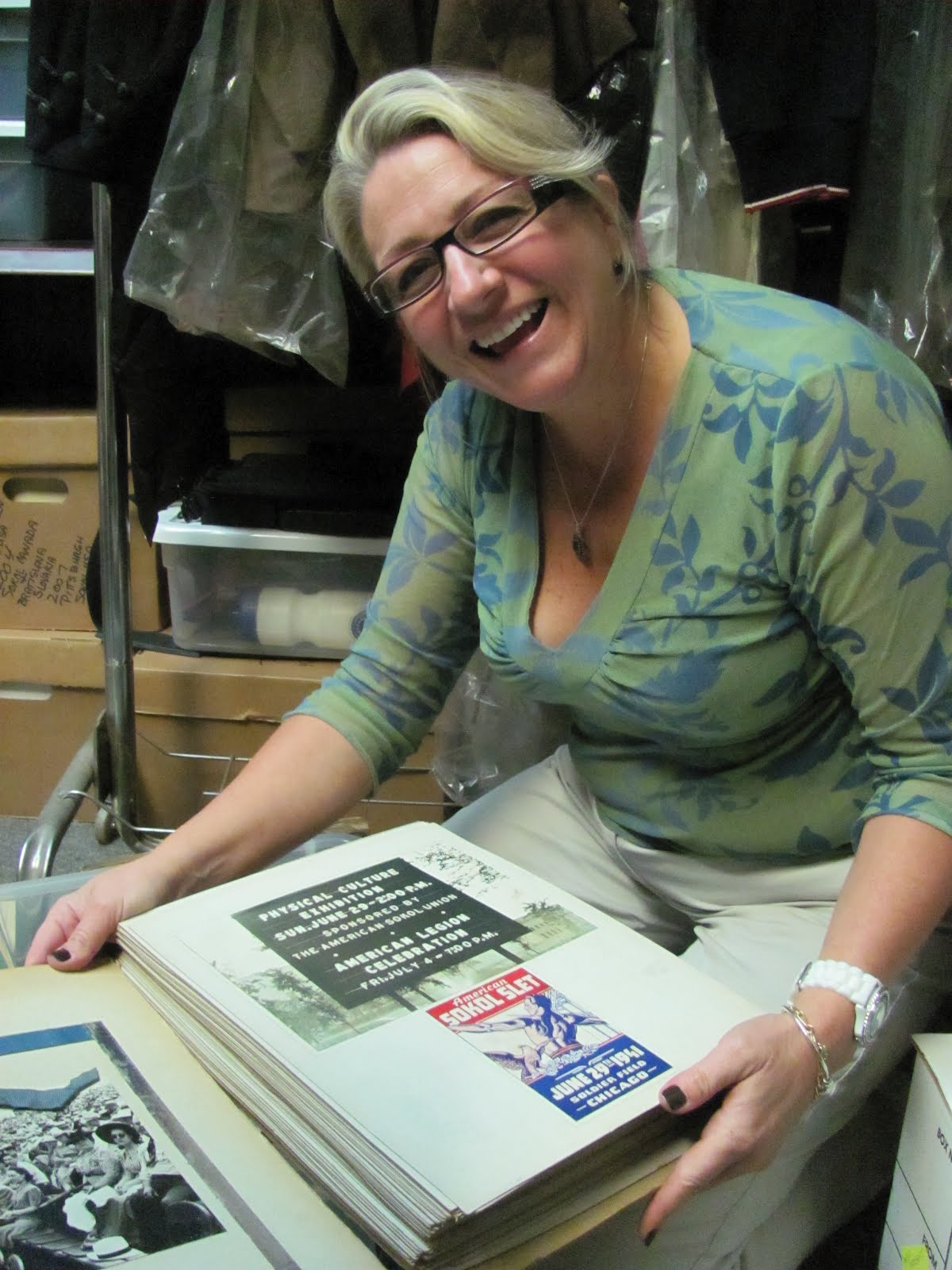
Above: Jean Hruby with a photo album from a Sokol slet at Chicago's Soldier Field, below: a photo from the album showing slet participants, 1941

The archives are particularly rich in photos and other documentation of previous Sokol slets – mass gymnastics festivals at which thousands of Sokol members perform synchronized gymnastics routines.


Photo from the Prague Sokol slet of 1948

For more information on American Sokol and the organization’s library and archives, visit www.american-sokol.org.

Wednesday, July 6, 2011

Slovo, Summer 2011


Cover of Slovo, Summer 2011

A new edition of the NCSML’s journal Slovo is out, and the whole issue is devoted to Recording Voices & Documenting Memories. Here are extracts from some of the articles written for Slovo by oral history project participants alongside images they shared with the NCSML at the time of their interview.


Portrait of Karel Ruml, 1949

Karel Ruml left Czechoslovakia in 1951 by “crashing a train through the Iron Curtain into West Germany.” In this edition of Slovo, he remembers his escape:

“My own task was to prevent anyone from using the single manual brake in my coach. With the train in motion… I got up and walked slowly to the end of the corridor, where I casually leaned on the wheel of the brake. Soon we were racing through As and a big, self-assured border guard tried to push me aside. I quickly drew my gun and ordered him to stop and keep quiet. He glared at me with a mixture of hate and cowardice, but didn’t move… We finally stopped among farm fields. Not too far behind us was a forested ridge bristling with watch towers and barbed wire – the Iron Curtain… Bewildered passengers [milled] outside the train.”


Birthday card designed by John Palka, circa 1950

In Twice Displaced But Not Defeated John Palka (who came to the United States in 1941 and then again in 1949) writes:

“…My parents worked hard to raise me with a dual identity – that of a devoted American grateful to his new homeland for the safety and opportunities it offered him, but also that of a Slovak who knew about and was proud of his heritage. In this they succeeded, for that is the way I still see myself today. After her death, I found in my mother’s files a memento that expresses this duality perfectly, a birthday card I made for her. On the front I wrote Happy Birthday and Št’astlivé narodzeniny, and on the back I drew two flags, the Czechoslovak above and the U.S. flag below. I was 11 or 12 when I sat down with my crayons to make this card.”


Jana Svehlova with her father, Jan Roubik, in England during WWII

Jana Svehlova is the founder of a non-governmental organization called The Enemy’s Daughters. She herself is the daughter of a political prisoner, her father having been arrested in 1949 because he was an RAF pilot during WWII and, she says, “the communist regime viewed those who had fought for the Allies with hostility.” In Slovo, Jana recollects her father’s arrest:

“The only clear image I have of that day is the color of my dad’s face when the agents were taking him away at 9 o’clock in the morning – stark white. I did ask one of the men, 'Where are you taking my daddy?' The security agent answered, 'We have to ask him some questions.' My father was arrested and sentenced to 10 years of hard labor… My mother and I were able to visit him about two times a year.”


Vladimir Maule's ID card, circa 1969

In From Lenin to Lennon, Vladimir Maule remembers his youth in Prague and journey to America in 1969. He settled with his mother in what was then a particularly Czech neighborhood of Chicago:

“As we walked along 26th Street, we heard some voices speaking in Czech. The sound was coming out of a travel agency. It was a social group of elderly Czechs at their monthly meeting, where they discussed global events and exchanged cooking recipes. They were genuinely happy to help. They found a place for us to stay the first night and recommended where to apply for work – my mom at Western Electric and I at a steel company called CECO. The next day we were both hired. (I had taken the wrong bus so ended up at Sears.) We found a basement apartment in Berwyn, a Chicago suburb with a sizable Czech population. We were on a roll.”

Vladimir talks more about the mix-up which led him to find employment at Sears (and not CECO) in this clip from his oral history interview:


Also in this edition of Slovo are articles by project participants Melania Rakytiak and Peter Hruby. Slovo is sent to all NCSML members and can be purchased at the museum store in Cedar Rapids.

Saturday, June 4, 2011

Recording in Chicago: May 23-28

The NCSML was in Chicago between May 23 and 28, recording more interviews as part of its oral history project. Here's a preview of some of the materials we gathered - check our website for interviewee profiles over the months to come:


Dagmar Kostal grew up in Susice, Czechoslovakia. Her parents owned a bakery in the town and so the family did not go hungry during WWII, she says. Dagmar left Czechoslovakia to train as a pastry chef in Switzerland after the War. She immigrated to Australia following the Communist coup in Czechoslovakia in 1948.


Today, Dagmar lives in Berwyn, IL with her son.

Geraldine Kraupner left Czechoslovakia with her husband following the Communist coup in 1948. She spent over a year in refugee camps in Germany before coming to America. She was very active in the patriotic sports organization Sokol. Here is a program she kept from a Sokol gathering in Ludwigsburg refugee camp in 1949:


Today, Geraldine lives in Forest Park, IL:


Vlastimil Surak left Brezova pod Bradlom, Slovakia, for Chicago in 1948. At his interview, he showed us this photo of himself as a baby in his hometown in 1927. Vlastimil is the child in the pram, which he says was brought back from America by his parents, who had already spent time in the United States:


Vlastimil's family owned a tannery in Brezova pod Bradlom. When he came to the United States, he eventually raised the funds to set up his own tanning business in Chicago. Here's a picture of one of his employees at work in the 1950s:


Valentin Turansky came to the United States after leaving Czechoslovakia with his family in 1948 and spending time in Belgium and then Australia. He joined the Slovak soccer club in Chicago:


In Chicago, Valentin worked as a printer in a part of town which is still referred to today as Printer's Row:


Alice and Eda Vedral told us their stories of leaving Czechoslovakia in 1948 and 1949 respectively. Here they are pictured in their home in Cicero, IL with their eldest daughter, also called Alice. Watch our web pages for their stories over the months to come: