Showing posts with label Food. Show all posts

Wednesday, June 12, 2013

New Transcripts at the NCSML

Voucher for buying goods at Tuzex stores in Czechoslovakia

More oral histories have been transcribed as part of Recording Voices & Documenting Memories. Full transcripts are available to researchers upon request at the National Czech & Slovak Museum & Library.

In this excerpt from an interview with Dasa Kozakova, she remembers shopping - and the shortage of goods - in Czechoslovakia during the 1970s and 1980s:

"There wasn’t toilet paper. So my father-in-law was forever sitting and cutting newspapers into little squares. Really! There just wasn’t paper... And, for example, onions - all of a sudden for four months there weren’t any onions. And it is difficult to cook Czech food without onions. Czech food has lots of sauces and their base is an onion.
 

"I would always pull up at a store with the kids in a pram and ask what was on sale. Then we would stand in the queue and buy as much of it as we could, because we gave it then to my parents and my mother-in-law too, so that everybody had. And that was it, quite simply - the constant struggle for ordinary things. Then, when I went to work (I worked at Albertov),  there was a little store, and I had to go there at noon to buy bread. Because if I went when I finished work at 3:30, there wasn’t any more. So, there were all of these nonsensical things. In the end, everyone had bread, but with such difficulty! 

"When the boys had just started at primary school, my son sat beside a greengrocer’s son. And the greengrocer’s son was always bringing in oranges or apples – these sorts of things – and my son never had them, because I wasn’t capable of finding them. I went into the grocery store and there were potatoes, maybe carrots. There just weren’t these sorts of things. And so I, even though I didn’t like it, after about half a year of my son saying ‘I want an orange too!’ I said ‘You can’t have one! Oranges are for Christmas!’ – because all of a sudden there were oranges then. Everyone could buy two kilos. They were Cuban, they were ugly – they were good, but they were ugly. They didn’t look good, but they were juicy. So I went to the greengrocer, the kid’s father, and asked him either to stop giving his son this fruit, or to give it to mine too!"

..."Meat was also impossible to find. There was always beef brisket. And if you were lucky there was shank or ribs. But we never saw sirloin. We never saw that sort of meat. You just couldn’t get it, not even in restaurants. I don’t know. You couldn’t find rump steak. Ham? I don’t know where that disappeared. Because again, all you could get was pork belly, you know. So belly and pork brisket you could get. And always on Monday the butcher’s was closed. And so for meat on Tuesday there were queues from first thing. My mother-in-law, she still came from that old school and she still cooked and so she always stood in these queues so as to buy fake tenderloin or something of the sort. So meat was also a big problem. Finding bacon? And ham? Not possible! For a normal person, that is, who didn’t have any connections…"

How were the stores back then? 

"Everybody went about with a string bag. This was a type of bag which looks quite modern – maybe not now but a couple of years ago this bag reappeared. So everyone had a string bag, and when someone by chance saw something available, they bought it!"

Wednesday, June 5, 2013

Recording Voices & Documenting Memories in Florida

Late this May, Recording Voices & Documenting Memories made its first trip to Florida. The NCSML recorded the stories of a number of Slovaks and Czechs who had settled in and around Sarasota and Miami in particular.

Emil and Elena Brlit in The Brlit Dental Lab
Emil at work in the Brlit Dental Lab

The first stop was Brlit Dental Lab to meet Emil and Elena Brlit. Emil left Czechoslovakia with his family in 1969, while Elena came to the United States more recently, in 1983. Following each of their interviews, they shared a number of old photographs with Recording Voices & Documenting Memories:

Elena dressed in local kroj as a child in Slovakia

Emil (fifth from left, front row) with the Sarasota Slovak Soccer Club, 1990s


In Miami, the NCSML spoke with Luba DeWitt, head of the local Czech-Slovak Cultural Club. Following her interview, she showed Recording Voices & Documenting Memories the Club’s North Miami home, where a Sunday lunch of goulash was being served:

Luba DeWitt in front of the Miami Czech-Slovak Cultural Club

Preparations for lunch at the Czech-Slovak Clutural Club, Miami

Finally, the NCSML met with Dr. Tomáš Gral, who moved to the United States age 39 in 1964. Dr. Gral shared his experiences of incarceration at Auschwitz and Gleiwitz during WWII, and his memories of studying at medical school in Bratislava immediately after the War.

Portrait of Dr. Tomáš Gral from 1945

Dr. Gral in his apartment, 2013

For clips from Dr. Gral’s and each of these other interviews, follow the NCSML’s oral history web pages over the months to come. 

Monday, September 10, 2012

Bistro Bohém, Washington, D.C.


Bistro Bohém is located in Washington, D.C.’s Shaw neighborhood. The “Bohemian-styled” restaurant was opened by Czech-American Jarek Mika in spring 2012.

Jarek Mika at Bistro Bohém, September 2012

A former banker, Jarek left his job in finance a couple of years ago to study at culinary school. He says his cooking at Bistro Bohém is influenced in equal part by what he learned at college and his Czech grandmother’s traditional recipes.

Bistro Bohém's menu, September 2012

The goulash and vepřo, knedlo, zelo (pork, dumplings and cabbage) at Bistro Bohém are accompanied by a formidable cocktail list. Diners can choose from Bohemian Margaritas, Fernet Martinis or Becherovka Old Fashioneds - to name but a few of the Czech-ified drinks.


In early September, Bistro Bohém doubled in size when it opened a café in the building next door.

The newly-opened Kafé Bohém

Bistro Bohém is open every day except Monday at 600 Florida Ave NW, Washington, D.C. Watch the NCSML’s oral history pages for clips from an interview with owner Jarek Mika over the months to come.

Thursday, September 6, 2012

Recording Voices & Documenting Memories in Washington, D.C.

It has been a long time since Recording Voices & Documenting Memories staff were in Washington, D.C. This August, the NCSML set out for the capital to record the stories of a number of Czech & Slovak immigrants who settled there after the Velvet Revolution in 1989. Here is a small sampling of some of the materials gathered:

Photo courtesy of Jana Kopelentova Rehak

Anthropologist and photographer Jana Kopelentova Rehak settled in the United States in 1994. In the Czech Republic she had worked as a photographer and studied at the film and photography school FAMU in Prague. She continued her studies in the United States, writing her doctoral thesis on Czech & Slovak political prisoners, whom she also photographed. Today, she lives in Baltimore and teaches at Towson and Loyola Universities:

Jana Kopelentova Rehak at home in Maryland

Ludmila Sujanova came to the United States from Kosice, Slovakia. She settled first in New York City and then Florida before coming to Germantown, Maryland. Following her interview with Recording Voices & Documenting Memories, she shared these photos from her youth in Eastern Slovakia:


While in D.C., we revisited former interviewee Juraj Slavik and rummaged through some of his old class photos from the Czechoslovak State School of Great Britain during WWII. Here’s an image from a music lesson complete with the Allied powers’ flags as classroom decoration:


In this clip from his interview with Recording Voices & Documenting Memories, Juraj remembers his school days in Great Britain during WWII:


The NCSML also met with Czech restaurant owner Jarek Mika while in Washington. Look out for another blog post about his business, Bistro Bohem, over the weeks to come:

Jarek Mika at Bistro Bohem, September 2012

… And be sure to check the NCSML’s oral history pages for each of these interviewee’s profiles and more!

Tuesday, March 20, 2012

San Francisco’s Café Prague


Café Prague, Merchant Street, San Francisco

Café Prague is located in San Francisco’s Financial District and owned by Czech émigrés Alena and Mirek Kucera.


Alena and Mirek Kucera at Café Prague, March 2012

This being California, the menu balances Czech staples such as duck and cabbage with organic salads and healthier sandwiches.


Menu from Café Prague, March 2012

When Recording Voices & Documenting Memories paid the café a visit, it was gearing up for Saint Patrick’s Day – hence the proliferation of shamrocks alongside the otherwise Czech décor.


Interior and window of Café Prague adorned with shamrocks

One of the highlights at Café Prague is the Czech beer served on tap. The Kuceras serve draught Pilsner Urquell and Staropramen, and often have Krusovice beer as well.


Draught beer at the bar at Café Prague and a Krusovice sign outside the restaurant

On Fridays, there is generally an informal gathering of San Francisco’s various Slavic communities at the café. For more information on this, go to the restaurant’s Facebook page.

Tuesday, February 21, 2012

Czechs & Slovaks Around the World


Cover of The Australian Slovaks' Calendar, 1957, courtesy of Anne McKeown

While Recording Voices & Documenting Memories focuses on Czechs and Slovaks who immigrated to the United States, it is important to remember that this is only one part of the story, and that thousands of Czechs and Slovaks settled elsewhere around the globe.

Here are a few of the highlights from our own oral history collections, which show some of the other locations in which Czechs and Slovaks set up a new home at various points throughout the past century:

Vera Borkovec, who was born in Prague, lived with her family in Tehran, Iran until after WWII. Her father worked as the director of the Škoda factory in the city, which employed a number of expatriate Czechs, some of whom are photographed below:


Vera Borkovec's father (second row from the bottom, fourth from right) with colleagues from Škoda Tehran

Joseph Ben David fled Czechoslovakia in 1939 and lived in Israel until 1954. The picture below shows him on the beach in Tel Aviv in the early 1950s.


Portrait of Joseph Ben David, Tel Aviv

Vera Roknic found herself stranded in Sweden, where she was on a work placement, at the time of the Communist coup in Czechoslovakia in 1948. She lived there for a number of years before emigrating to America in 1952. This photo shows her on a camping trip in the Swedish countryside with her late husband, Vaclav (himself a Czech émigré in Sweden):


Vera Roknic camping in Sweden, 1950

Jerri Zbiral, meanwhile, lived in Norway for three years before emigrating to Canada with her family. She refers to the years she spent growing up in Norway as ‘extremely happy.’


Jerri Zbiral competing in a skiing competition in Norway, 1954

A large number of Czech and Slovak emigres settled in Canada during the Cold War period. The photo below shows Ivana Edwards’ father selling Czech and Slovak books at a summer fair there in the 1950s. His International Book Service operated out of the Edwards’ adoptive hometown, Montreal.


Oliver Gunovsky settled in 1970 in Kitchener, in the Canadian province of Ontario, after two years spent in England. He found work in the restaurant business and eventually came to own the city’s Metro Tavern, which he says specialized in Central European fare - in particular schnitzels:


Promotional postcard for Metro Restaurant & Tavern, Canada

Émigré Otto Ulc has spent years documenting the stories of Czechs and Slovaks who settled around the world. This photo from his collection shows the Czech staff at Praga Technical Services & Manufacturers in Pretoria, South Africa:


Two good websites with lots of information about Czechs and Slovaks around the globe are krajane.net (in Czech) and Slováci vo svete (in Slovak).

Monday, October 31, 2011

Czech & Slovak Family Restaurants


In the course of working on Recording Voices & Documenting Memories, food has been an important theme, and a good number of the people the National Czech & Slovak Museum & Library has spoken to have owned their own family restaurant, either here in the United States or in Europe prior to their departure.

Dusan Ciran’s stepfather, Emil Sarvady, owned a restaurant in the town of Senica, Western Slovakia, in the run up to WWII (the restaurant in question is pictured above, in more recent times). In this clip from Dusan’s interview with Recording Voices & Documenting Memories, he recalls serving German soldiers there during the War:


Robert Dobson, meanwhile, worked as a waiter (as well as a hair model) in Prague in the 1970s. When he came to Chicago with his family in 1984, he started working as a bartender in the city before buying Pilsner Restaurant in Berwyn three years later. He and his family ran the establishment for the next 13 years. In this clip from his interview, Robert remembers the most popular items on the menu:


Today, Robert runs a remodeling and construction firm based in Bolingbrook, Illinois.


Josef Tousek was a waiter and hotelier in Czechoslovakia before he came to Chicago in 1981. After working at Ciel Bleu French Restaurant in Chicago’s Mayfair Hotel for some years, he set up his own Alpine Banquet House, which now has two branches in the Greater Chicago Area. He shared photos of his restaurant on Roosevelt Road before and after reconstruction with Recording Voices & Documenting Memories:


Photos of Alpine Banquet House before and after renovation

Ales Vesely came to the United States in 1983. Today he works as a barman in Chicago’s Klas Czech Restaurant (where this photograph was taken):


Of Klas Restaurant and the neighborhood, Cicero, in which it is found, Ales says: “…It used to be all Czech over here. I remember we’d drive down Cermak Avenue and there would be Czech butcher shops, a bakery, other restaurants, Czech bars, even Polish places. And now you drive down Cermak Avenue and pretty much it’s all Spanish. This is the last Mohican on Cermak Road. I love this place, it’s very unique."

Wednesday, October 12, 2011

Vltava Czech & Slovak Grocery, Chicago


Vltava Czech & Slovak Grocery, W Belmont Ave., Chicago

According to its owner, Tomas Votocek, Vltava is the only shop dedicated exclusively to Czech & Slovak goods in Chicago. Mr Votocek bought the store four years ago and transformed it from a Polish grocer’s into an outlet selling Czech & Slovak food, videos, books and ceramics.


Owner Tomas Votocek behind the counter at Vltava

Vltava is located at 7416 W Belmont Avenue in Chicago and open seven days a week. Customers from further afield can order goods through the store’s Czech-language website, which will then be delivered for a shipping fee throughout the United States.


Books on sale at Vltava - featured is a cookbook from 1968 offering readers 'humorous' recipes

The store stocks a number of Czech and Slovak books and magazines. Books sold are a mixture of brand new and second hand. Earlier this week, there were a large number of cookery books in particular on sale.


Goods on sale at Vltava

Owner Tomas Votocek says he works with a local Polish baker to produce bread baked according to a Czech recipe. Mr Votocek buys perishable Czech & Slovak delicacies like šunka v aspiku (ham in aspic), ruské vejce (egg salad) and chlebíčky (open sandwiches) from a local Czech woman who makes them for him specially. The rest of the food is imported from the Czech Republic and Slovakia.


Singer Karel Gott at Vltava (photo courtesy of vltava.us)

At Vltava, customers can also send parcels, flowers or money orders to the Czech Republic or Slovakia, convert videos from European PAL into US NTSC format and even buy tickets for Czech & Slovak cultural events in Chicago. As the image above shows, Vltava acted as a ticket office for Karel Gott’s 2009 American Tour (more photos can be found online at http://www.vltava.us/gott.html).

Look out for video highlights from Recording Voices & Documenting Memories’ interview with Czech-born owner of Vltava Tomas Votocek on the NCSML’s website over the weeks to come.

-Posted by Rosie Johnston

Tuesday, July 26, 2011

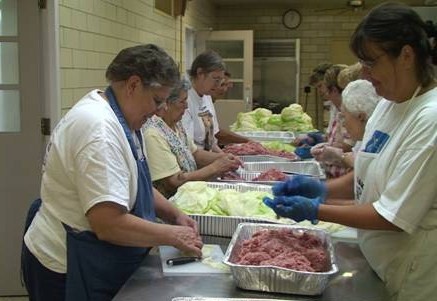
Holúbky making for the Cleveland Slovak Festival, September 2010

The Cleveland Slovak Festival has been held annually over the Labor Day weekend since 1971. Last year, it took place at St. Anthony of Padua Church in Parma, Ohio. Festivalgoers enjoyed a number of accordion bands, Slovak folk dance performances, Zlatý bažant beer and hearty portions of Slovak food.

Ahead of the festival on September 4, I joined the twenty-some volunteers preparing holúbky for the festival. Holúbky (which literally means ‘pigeons’) are stuffed cabbage leaves traditionally made, according to those at the festival, in the eastern Zemplín region of Slovakia. Here’s a photo guide showing how to make the perfect stuffed cabbage leaf:


First of all, you need to boil your cabbage. This makes the individual leaves more pliable so you can wrap them easily around the stuffing later on. At the festival, the hearts of each cabbage were then used in a tomato/cabbage-based sauce served over each of the holúbky. From my understanding, this is something of an optional flourish; holúbky can be served plain as well.


This photo of a fraction of the boiled cabbage leaves piled high gives you an idea of the quantities of holúbky being made for the festival.


Next up is the stuffing: the recipe used at the Slovak festival called for pork and beef to be mixed with rice and seasoned with salt and pepper. Onions sautéed in butter were also added to the mixture and worked in, as you can see, using a good deal of elbow grease.


With the leaves and the stuffing now prepared, it was time to make the holúbky themselves. To do so, small meatballs were prepared (as shown on the front right of this picture) and then wrapped in cabbage leaves (as shown on the front left).


Finally, the end of the cabbage leaf needs to be tucked into the roll so that the filling stays firmly in place. If the cabbage leaf is too long, then Mary Lesko (pictured) suggests you should cut it down so that it fits better. The scraps of cabbage left over became part of the holúbky sauce.

At the festival, the holúbky sold like hot pigeons and I didn’t notice any left at the end of the day. According to festival founder Paul Brunovsky, who spoke to the NCSML’s Recording Voices & Documenting Memories, food and drink have proven to be a major part of the event's allure since it was founded 40 years ago:


This year, the Cleveland Slovak Festival will be held on September 4th, again at St. Anthony of Padua Church in Parma, Ohio. The NCSML will be there with information about the museum and Slovak products for sale.