Showing posts with label Canada. Show all posts

Tuesday, March 27, 2012

Recording Voices & Documenting Memories in the San Francisco Bay Area

The NCSML’s recent trip to California uncovered all sorts of particularly interesting historical documents and stories. Here are some of the highlights from Recording Voices & Documenting Memories most recent material-gathering expedition:


Georgina Teyrovsky’s father was a member of the Czechoslovak Legions in Russia. In this photo from 1918 he is at work as a telegraphist (sitting in the bottom row, second from left).


George Malek originally immigrated to Canada before coming to the United States to work in what was a fledgling Silicon Valley. During his interview with Recording Voices & Documenting Memories, he shared this picture with us: the photo shows his mother, who was a member of a Sokol dance troupe in Czechoslovakia prior to WWII. She is the dancer in the front row furthest to the right.


Two images of Prague during the Warsaw Pact Invasion, 1968

George Skoda left Czechoslovakia in 1948. He subsequently settled in the Bay Area and worked on the Stanford Two-Mile Accelerator. He says that he was sent the photos above by a friend in Prague following the Soviet-led invasion of Czechoslovakia in 1968.


Peter and Hana Palecek arrived in the Bay Area in the late 1960s. Although they were married at the time, the pair arrived in the United States separately, and in totally different ways. The Paleceks both shared their stories with Recording Voices & Documenting Memories.

Excerpts from all of these interviews, and more from the NCSML’s recording trip to the Bay Area, will appear on the National Czech & Slovak Museum & Library’s oral history web pages over the weeks and months to come.

Tuesday, February 21, 2012

Czechs & Slovaks Around the World


Cover of The Australian Slovaks' Calendar, 1957, courtesy of Anne McKeown

While Recording Voices & Documenting Memories focuses on Czechs and Slovaks who immigrated to the United States, it is important to remember that this is only one part of the story, and that thousands of Czechs and Slovaks settled elsewhere around the globe.

Here are a few of the highlights from our own oral history collections, which show some of the other locations in which Czechs and Slovaks set up a new home at various points throughout the past century:

Vera Borkovec, who was born in Prague, lived with her family in Tehran, Iran until after WWII. Her father worked as the director of the Škoda factory in the city, which employed a number of expatriate Czechs, some of whom are photographed below:


Vera Borkovec's father (second row from the bottom, fourth from right) with colleagues from Škoda Tehran

Joseph Ben David fled Czechoslovakia in 1939 and lived in Israel until 1954. The picture below shows him on the beach in Tel Aviv in the early 1950s.


Portrait of Joseph Ben David, Tel Aviv

Vera Roknic found herself stranded in Sweden, where she was on a work placement, at the time of the Communist coup in Czechoslovakia in 1948. She lived there for a number of years before emigrating to America in 1952. This photo shows her on a camping trip in the Swedish countryside with her late husband, Vaclav (himself a Czech émigré in Sweden):


Vera Roknic camping in Sweden, 1950

Jerri Zbiral, meanwhile, lived in Norway for three years before emigrating to Canada with her family. She refers to the years she spent growing up in Norway as ‘extremely happy.’


Jerri Zbiral competing in a skiing competition in Norway, 1954

A large number of Czech and Slovak emigres settled in Canada during the Cold War period. The photo below shows Ivana Edwards’ father selling Czech and Slovak books at a summer fair there in the 1950s. His International Book Service operated out of the Edwards’ adoptive hometown, Montreal.


Oliver Gunovsky settled in 1970 in Kitchener, in the Canadian province of Ontario, after two years spent in England. He found work in the restaurant business and eventually came to own the city’s Metro Tavern, which he says specialized in Central European fare - in particular schnitzels:


Promotional postcard for Metro Restaurant & Tavern, Canada

Émigré Otto Ulc has spent years documenting the stories of Czechs and Slovaks who settled around the world. This photo from his collection shows the Czech staff at Praga Technical Services & Manufacturers in Pretoria, South Africa:


Two good websites with lots of information about Czechs and Slovaks around the globe are krajane.net (in Czech) and Slováci vo svete (in Slovak).

Thursday, December 1, 2011

Recording Voices & Documenting Memories in Toronto, November 2011

This November, the NCSML was invited to Toronto to present Recording Voices & Documenting Memories. Never ones to pass up on a good recording opportunity, we met a number of Czechs and Slovaks who immigrated to Canada over the past 60+ years whilst we were in town. As ever, look to our web pages for excerpts from the interviews over the next couple of weeks. Here is a fraction of the interesting photos and other archival documents which our interviewees shared with us when we visited their homes:


Czech ball, Montreal - photo courtesy of George Heller

George Heller came to Canada with his parents shortly after the Communist coup in 1948. The family settled in Montreal. The photo above shows George’s parents (on the far right) at the city's yearly Czech & Slovak ball, which he says was the émigré community’s annual social highlight.


Photo of George Heller's father, Havlickuv Brod, 1948

Prior to leaving Czechoslovakia, George’s father was a baker. In this photo from 1948, George’s father is shown taking part in a parade in Havlickuv Brod representing the bakery he worked for at the time, named Rozvoj (meaning progress or development in Czech). Along the side of the truck are both Czech and Soviet flags and a caption which reads “sixty-nine wagons of bread baked in 1947 – 4,650,000 bakery items.”


George (in the blue coat on the right) with Queen Elizabeth II, 1994

When George was 18, he answered an advert posted by the Hudson’s Bay Company recruiting fur traders to work in Canada’s Northern Territories. He enjoyed tremendous success at this job and, after a number of promotions and some time spent in other firms, rose to the position of president and CEO of The Bay. He took some time off from this job to organize the 1994 Commonwealth Games, which were held in Vancouver. In the photo above, George is watching the Games’ opening ceremony with Queen Elizabeth II and the Duke of Edinburgh.


Dagmar Benedik with fellow members of the swim team, Kladno

Dagmar Benedik left Czechoslovakia with her family in 1968. Prior to emigration, she attended junior and senior high school in Kladno, where her father was coach of the junior hockey team, and enjoyed swimming competitively for the city, as evidenced by the photo above, in which Dagmar can be seen on the top left.


Envelope containing correspondence from Dagmar's pen pal

Following her interview with Recording Voices & Documenting Memories, Dagmar shared a number of interesting documents with the NCSML, including this envelope which she received from her pen pal in the Soviet Union in the 1960s. Dagmar says that Czech and Slovak schoolchildren would often write to a peer in the Soviet Union as part of their Russian language training at this time. This particular letter came encased in an envelope commemorating February 23 - Soviet Army Day.


Milos Krajny upon arrival in Canada beside Professor Julius Axelrod (left)

Milos Krajny also came to Canada in 1968 to work in Quebec as a medical doctor. He subsequently moved to Toronto where he opened his own practice and, among other achievements, became the president of the Toronto Philharmonic. Dr. Krajny is extremely active in the Czech community in Toronto and organizes a series of classical music performances called Nocturnes in the City, about which more details can be found here.

Excerpts from all three of these interviews and more will be posted to www.ncsml.org over the weeks to come.

Wednesday, November 23, 2011

The Slovak Canadian Heritage Museum in Oshawa, November 2011


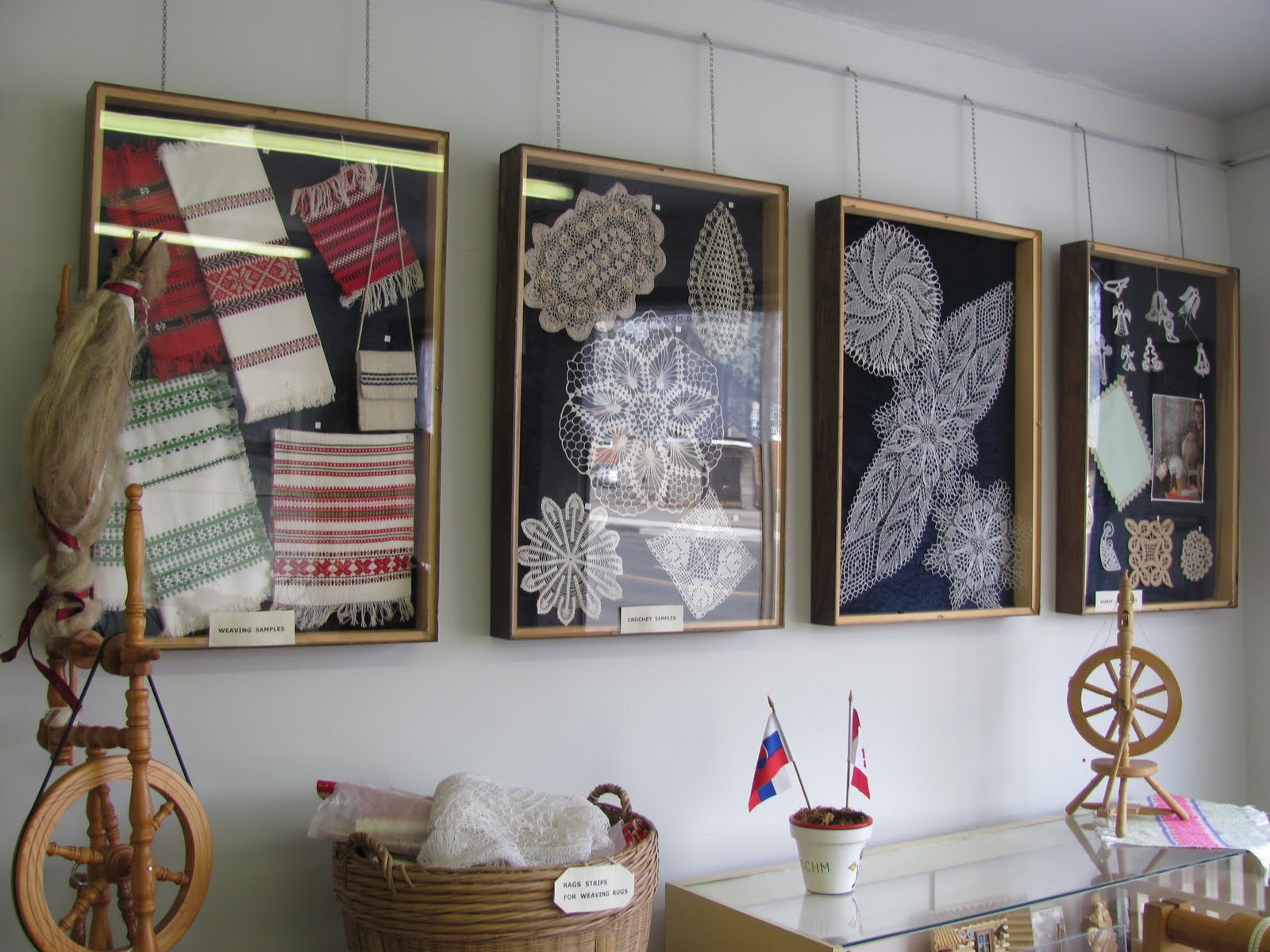
The Slovak Canadian Heritage Museum (SCHM) opened in Oshawa in 2010 with the aim of making audiences ‘aware of Slovak heritage in Canada through the exhibition of heritage artifacts.’ The museum (which had previously been located in Markham, a town to the West of Toronto with a long history of Slovak settlement) opened in Oshawa in a former furniture store, originally belonging to a Mr Michna, a Slovak immigrant who came to Canada in 1924. Of the new location (about 30 minutes to the East of Toronto), museum director Margaret Dvorsky says “it’s a good place to start, the city fathers are happy we are here.”


Museum president Margaret Dvorsky and Jaromir Lukac at the SCHM


Visitors to the museum can try their hand at weaving and a number of other traditional needle crafts. On display are items of bobbin lace, embroidered folk costumes (kroje) and fabrics which have been traditionally printed using wax and indigo dye.


Some of the textiles on display at the SCHM

As well as running the museum itself, Margaret, Jaromir, and other members of the SCHM committee organize an annual Slovak Heritage Festival. They packed Recording Voices & Documenting Memories off with a copy of the very first program for the Slovak Heritage Festival in 2004, which included a bilingual Slovak-English map of the festival site in Markham, ON:


Extracts from the first Slovak Heritage Festival program, 2004

More information about the Slovak Canadian Heritage Museum (including a number of particularly lovely photo galleries) can be found on the organization’s website, at http://www.schm.ca/. The museum is staffed by a corps of volunteers and open from Tuesday through Sunday at 485 Ritson Road, Oshawa, Ontario L1H 5K1.