Showing posts with label Cicero. Show all posts

Thursday, July 19, 2012

T G Masaryk Czech School, Cicero, IL

The Tomas Garrigue Masaryk School in Cicero, Illinois was founded in 1921:

Facade of the T G Masaryk Czech School, Cicero, IL

Trilingual reserved parking sign at the TGM School
Detail from the facade of the TGM School

To this day, it provides a space for both children and adults from the Chicagoland Area to come and learn the Czech language.


The school takes its name from the first Czechoslovak president, Tomas Garrigue Masaryk. To celebrate his birthday on March 7, some of the school’s students decorated the classrooms with scenes from his life:


Drawing of Tomas Garrigue Masaryk as a particularly muscular blacksmith

The school also has a comprehensive library, and is home to a number of local Czech and Slovak organizations:


During the summer, children can attend Czech-language summer school. On Wednesdays, Czech-American Pavlina Parks runs a music class for toddlers:


Pavlina Parks at the TGM School

The school has a large garden, in which pupils grow vegetables and where they can play:


School caretaker Sharon in the TGM playground

In her interview with Recording Voices & Documenting Memories, teacher Irena Cajkova discussed her involvement with the T G Masaryk School:


For more information on the T G Masaryk Czech School, visit the organization’s Facebook page or call (708) 656-9810.

Thursday, March 29, 2012

American Sokol Headquarters, Brookfield


Chicagoland Sokol poster, date unknown

American Sokol was founded in St. Louis in 1865. Today, its headquarters are in Brookfield, Illinois.


Jean Hruby, American Sokol Headquarters, March 2012

Jean Hruby is American Sokol’s business manager. She says the organization is a non-political, non-religious, nonprofit active across the United States – particularly throughout the Midwest, on the East Coast and in Texas.


Bust of Sokol founder Miroslav Tyrš, American Sokol Headquarters

Czech patriot Miroslav Tyrš founded the Sokol movement in the Czech lands in 1862. According to Jean Hruby, American Sokol stays true to his principles to this day; Sokol members adhere to Tyrš’s credo of ‘a sound mind in a sound body’ through attending Sokol fitness, gymnastics (and even Zumba) classes, and cultural events put on by the organization.


'Anthem Etiquette' on the cover of American Sokol's newsletter, October 2011

Patriotism plays an important role in the Sokol ideology. Many of the organization’s members are both patriotic Czechs and Americans.


Artifacts (including a Czech governmental Gratias Agit award) and yearbooks on display at American Sokol

The headquarters of American Sokol in Brookfield double up as a library and archive housing the history of the organization. Researchers can visit the collections by making an appointment.


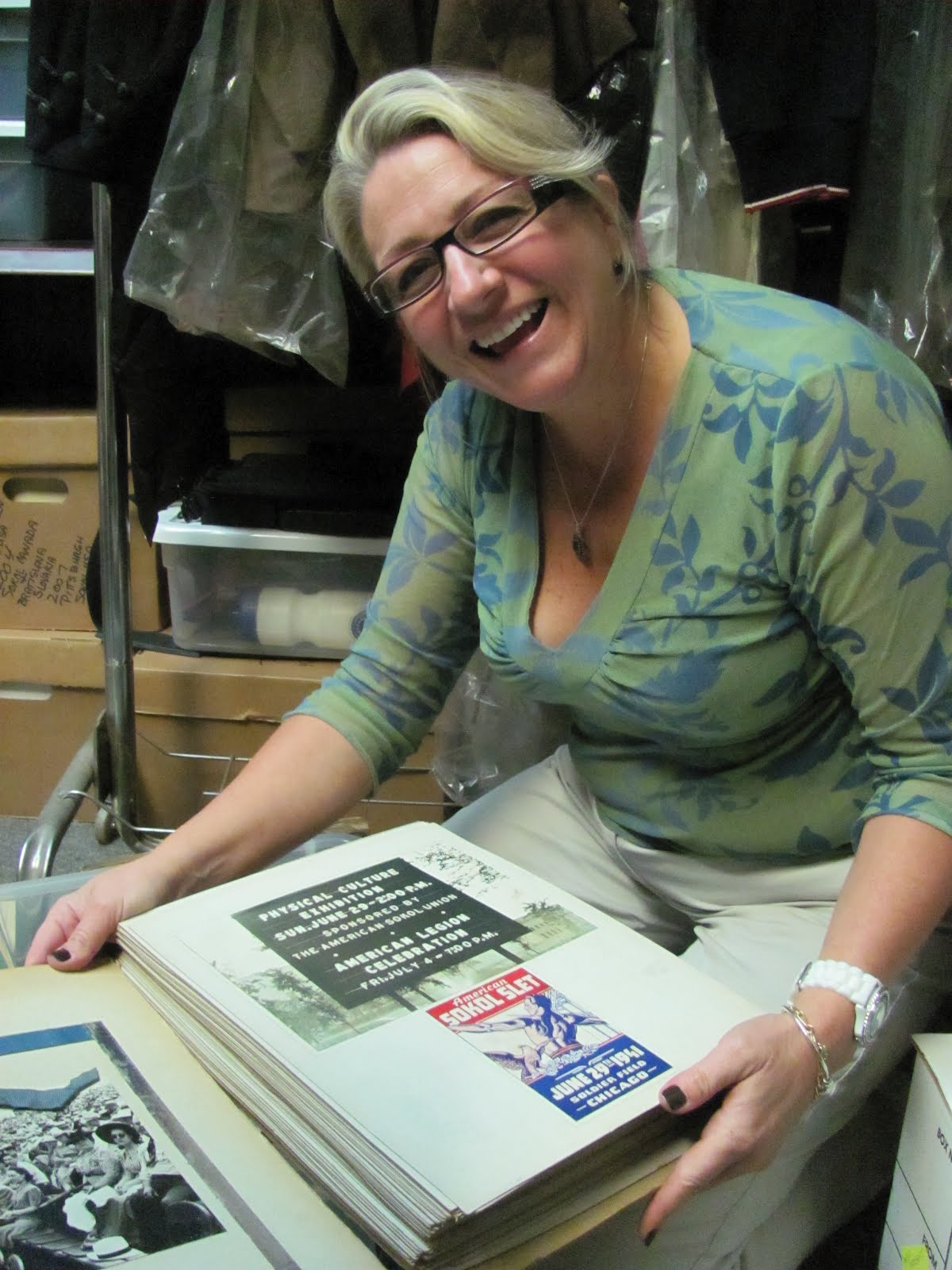
Above: Jean Hruby with a photo album from a Sokol slet at Chicago's Soldier Field, below: a photo from the album showing slet participants, 1941

The archives are particularly rich in photos and other documentation of previous Sokol slets – mass gymnastics festivals at which thousands of Sokol members perform synchronized gymnastics routines.


Photo from the Prague Sokol slet of 1948

For more information on American Sokol and the organization’s library and archives, visit www.american-sokol.org.

Monday, October 31, 2011

Czech & Slovak Family Restaurants


In the course of working on Recording Voices & Documenting Memories, food has been an important theme, and a good number of the people the National Czech & Slovak Museum & Library has spoken to have owned their own family restaurant, either here in the United States or in Europe prior to their departure.

Dusan Ciran’s stepfather, Emil Sarvady, owned a restaurant in the town of Senica, Western Slovakia, in the run up to WWII (the restaurant in question is pictured above, in more recent times). In this clip from Dusan’s interview with Recording Voices & Documenting Memories, he recalls serving German soldiers there during the War:


Robert Dobson, meanwhile, worked as a waiter (as well as a hair model) in Prague in the 1970s. When he came to Chicago with his family in 1984, he started working as a bartender in the city before buying Pilsner Restaurant in Berwyn three years later. He and his family ran the establishment for the next 13 years. In this clip from his interview, Robert remembers the most popular items on the menu:


Today, Robert runs a remodeling and construction firm based in Bolingbrook, Illinois.


Josef Tousek was a waiter and hotelier in Czechoslovakia before he came to Chicago in 1981. After working at Ciel Bleu French Restaurant in Chicago’s Mayfair Hotel for some years, he set up his own Alpine Banquet House, which now has two branches in the Greater Chicago Area. He shared photos of his restaurant on Roosevelt Road before and after reconstruction with Recording Voices & Documenting Memories:


Photos of Alpine Banquet House before and after renovation

Ales Vesely came to the United States in 1983. Today he works as a barman in Chicago’s Klas Czech Restaurant (where this photograph was taken):


Of Klas Restaurant and the neighborhood, Cicero, in which it is found, Ales says: “…It used to be all Czech over here. I remember we’d drive down Cermak Avenue and there would be Czech butcher shops, a bakery, other restaurants, Czech bars, even Polish places. And now you drive down Cermak Avenue and pretty much it’s all Spanish. This is the last Mohican on Cermak Road. I love this place, it’s very unique."

Saturday, June 4, 2011

Recording in Chicago: May 23-28

The NCSML was in Chicago between May 23 and 28, recording more interviews as part of its oral history project. Here's a preview of some of the materials we gathered - check our website for interviewee profiles over the months to come:


Dagmar Kostal grew up in Susice, Czechoslovakia. Her parents owned a bakery in the town and so the family did not go hungry during WWII, she says. Dagmar left Czechoslovakia to train as a pastry chef in Switzerland after the War. She immigrated to Australia following the Communist coup in Czechoslovakia in 1948.


Today, Dagmar lives in Berwyn, IL with her son.

Geraldine Kraupner left Czechoslovakia with her husband following the Communist coup in 1948. She spent over a year in refugee camps in Germany before coming to America. She was very active in the patriotic sports organization Sokol. Here is a program she kept from a Sokol gathering in Ludwigsburg refugee camp in 1949:


Today, Geraldine lives in Forest Park, IL:


Vlastimil Surak left Brezova pod Bradlom, Slovakia, for Chicago in 1948. At his interview, he showed us this photo of himself as a baby in his hometown in 1927. Vlastimil is the child in the pram, which he says was brought back from America by his parents, who had already spent time in the United States:


Vlastimil's family owned a tannery in Brezova pod Bradlom. When he came to the United States, he eventually raised the funds to set up his own tanning business in Chicago. Here's a picture of one of his employees at work in the 1950s:


Valentin Turansky came to the United States after leaving Czechoslovakia with his family in 1948 and spending time in Belgium and then Australia. He joined the Slovak soccer club in Chicago:


In Chicago, Valentin worked as a printer in a part of town which is still referred to today as Printer's Row:


Alice and Eda Vedral told us their stories of leaving Czechoslovakia in 1948 and 1949 respectively. Here they are pictured in their home in Cicero, IL with their eldest daughter, also called Alice. Watch our web pages for their stories over the months to come: